
TLS

Jumping Over a Low Hurdle
Telstra shares (ASX:TLS) recovered some ground last week, as the company reported fiscal 2018 numbers. The shares recorded their biggest single day gain in a decade last Thursday (+5.9%), as key figures exceeded muted expectations and the telecommunications titan held the line on its dividend. Optimistic comments regarding the growth opportunity from 5G also provided a boost.
The company declared a final dividend pay-out of 11 cents taking the total to 22 cents. Although that was lower than the 31 cents last year, it was in line with consensus expectations, after the company earlier flagged a dividend cut. Much of the damage to Telstra’s share price over the past 12 months has been due to the cut to the dividend, but expectations have now been reset lower, resulting in a relatively low hurdle to allow the share price to stage a recovery from current subdued levels.
Telstra has made some progress on the $3 billion earnings ‘hole’ resulting from the NBN rollout, ‘absorbing’ almost half that amount. Still, with conditions remaining challenging, the company has increased its focus on cost-cutting. The telco has accelerated its cost-out programme, with a further $1 billion in savings targeted by FY22, taking the total to $2.5 billion in annual savings. This will see a net reduction in 8,000 employees, impacting about one in four middle-management roles. A flatter corporate structure is envisaged to see an improvement in reducing the time to market for feature and product enhancements. FY19 restructuring costs are pinned at around $600 million.
A wide range of (often confusing) mobile plans will be reduced from around a staggering 1,800 to just 20. The roughly 1,800 plans for consumers and small businesses encompass about 400 currently on offer, while the rest are legacy plans in use, but not sold to new customers. Telstra also intends to monetise up to $2 billion from asset sales to strengthen the balance sheet.
Overall, given the fall in the share price over the past year or so and the plans in place to reduce the underlying cost base and simplify the business, the prospects for Telstra shares to outperform from current levels appears to be improving. Traction in the mobile area is solid, adding 342,000 retail mobile customers, 88,000 retail fixed broadband customers and 135,000 retail bundles in FY18. Core earnings in 2019 are expected to be in the range of $8.8 billion to $9.5 billion, excluding restructuring costs of around $600 million. Telstra will remain held in the Fat Prophets portfolio.
FY18 snapshot
Revenue from ordinary activities was effectively unchanged from a year ago at $26.01 billion, while other income increased by more than a third to $3.03 billion. Total revenue of $29.04 billion increased 3% from a year earlier.
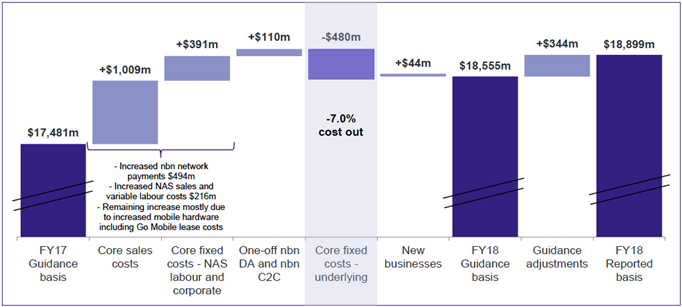
Group operating expenses increased 7.6% to $18.9 billion, driven by increased NBN access payments, NBN costs to connect (C2C), NAS growth and mobile hardware.
Core sales costs, which represent costs associated with revenue and customer growth increased by $1,009 million, or 13.6%. A bright spot on this front was a $480 million or 7% improvement in underlying core fixed costs. Labour costs of $5,157 million declined 4.2% year-on-year.
Source: Telstra
Earnings before interest, tax, depreciation and amortisation (EBITDA) declined 5.2%, pressured by the rollout of the NBN and lower ARPU (average revenue per user).
Net profit after tax (NPAT) from ordinary activities attributable to equity holders of $3,563 million declined 8.4% from a year earlier.
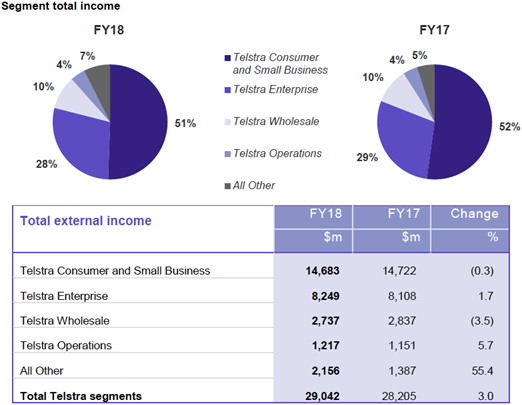
Turning to key segments and Telstra’s core Consumer and Small Business revenue declined 0.3% to $14,683 million. Within the segment, Consumer revenue edged up 0.6% with growth in post-paid handheld, mobile hardware and fixed bundle revenue, partially offset by declines in pre-paid handheld, mobile broadband and continued declines in the fixed voice business.
Small Business revenue declined 4%, with lower mobile services revenue and ongoing declines in fixed voice. Mobile services revenue edged down 2.5% as net subscriber additions were offset by declines in ARPU. Network Applications and Services (NAS) revenue increased 14.5%.
Revenue in the Enterprise segment increased 1.7% to $8,249 million. Enterprise domestic revenue edged up 0.8%, with solid growth coming from NAS. That was partially offset by ARPU declines across mobility and Data & IP, along with lower fixed voice revenue. Enterprise international income increased 5.4%, driven by growth from NAS, boosted by the acquisition of Company85 in June 2017.
Source: Telstra (ASX:TLS)
Wholesale segment income declined 3.5% to $2,737 million, mostly due to lower fixed product revenue. Revenue in the operations segment climbed 5.7% to $1,217 million. That was driven by an increase in NBN commercial work. All Other revenue jumped 55.4% to $2,156 million. The segment includes Technology, Innovation and Strategy, New Businesses (including Telstra Health) and Media & Marketing. A large amount of the increase in revenue for the broader segment stemmed from higher disconnection fees in line with the NBN network rollout.
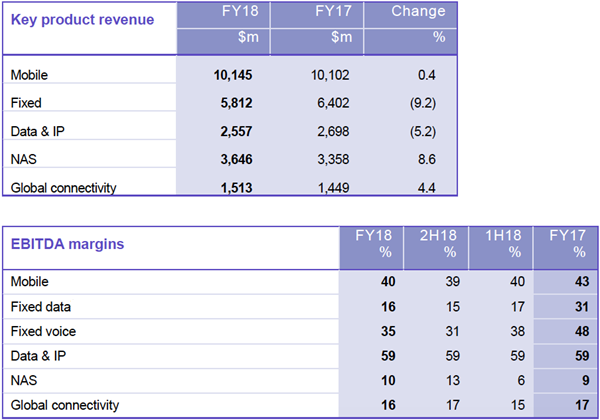
Looking at key products and mobile revenue ticked up 0.4% to $10,145 million. Retail customer service numbers increased 342,000 to take the total to roughly 17.7 million. Post-paid handheld retail customers increased 304,000 including 67,000 from Belong. The post-paid handheld churn rate of 10.9% compares well to competitors. Post-paid handheld revenue declined 1.4% to $5,374 million though, as ARPU continues to be under pressure, declining 3.4% to $65.41, with this largely attributed to intense competition. We expect the trend to continue. The mobile segment EBITDA margin fell 3 percentage points to 40% due to a decline in mobile services revenue and a smaller EBITDA benefit from the Go Mobile Swap relative to FY17.
Data & IP
revenue decreased 5.2% to $2,557 million, with customer growth in IP Virtual Private Network offset by legacy product declines including ISDN and calling products. The Data & IP earnings before interest, tax, depreciation and amortisation margin was stable at 59%. NAS revenue increased 8.6% to $3,646 million, with double-digit growth in Small Business and high single-digit growth in Enterprise. The segment is low margin, with the EBITDA margin falling 1 percentage point to 10%, with the downward move attributed to “ongoing operational leverage, scalable standardised offerings and cost productivity.”
Source: Telstra (ASX:TLS)
Global Connectivity
revenue increased 4.4% on a reported Australian dollar basis to $1,513 million. The segment represents the international business of Telstra Enterprise and there was ongoing growth in NAS and fixed products. The EBITDA margin slipped 1 percentage point to 16%, largely due to a shift in the revenue mix and yield pressure in the first half of fiscal 2018.
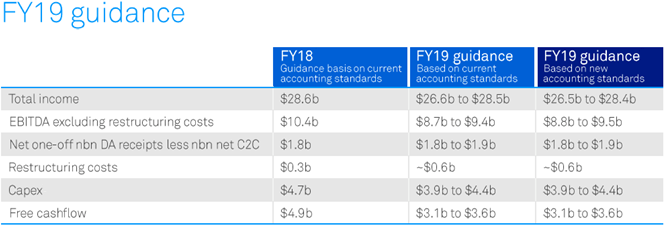
Looking ahead and based on new accounting standards, Telstra expects revenue of $26.5 billion to $28.4 billion in FY19, while EBITDA excluding restructuring costs of approximately $600 million is anticipated to be in the range of $8.8 billion to $9.5 billion.
Source: Telstra (ASX:TLS)
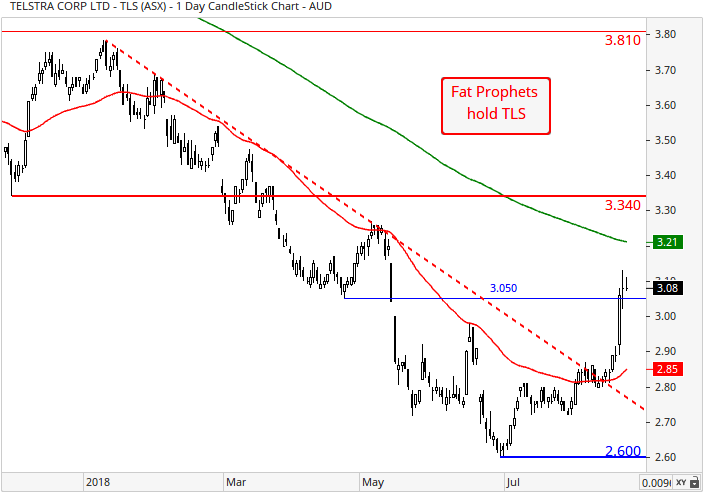
Turning to the charts, and the technical picture has improved significantly since our last review. Prices have moved up from dynamic support sighted at the 50-day moving average (red line) of $2.85. There has been a move above resistance at the April low of $3.05 in addition to a break above this year’s downward sloping trend-line. A move above the 200 day moving average ($3.21) would further strengthen the picture as would a recapture of resistance at the November 2017 low of $3.34. Next targets are previous resistance levels at $3.81, with a successful challenge here setting the scene for an eventual glide towards the psychological $4.00 level.
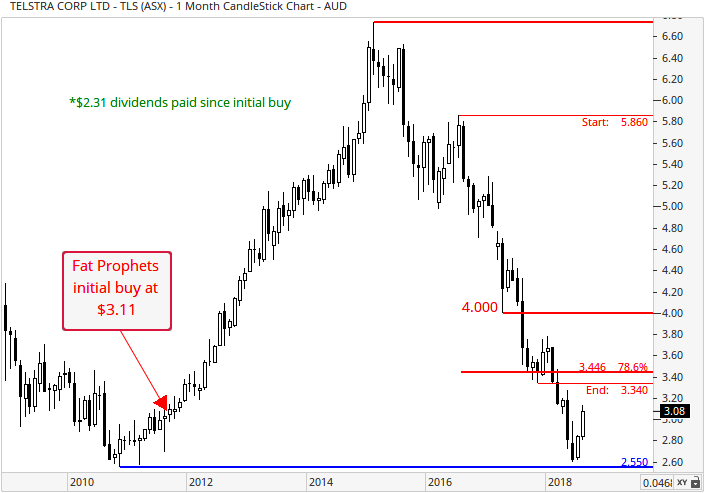
With reference to Telstra’s monthly chart, prior support at the 78.6% Fibonacci retracement of $3.45 (blue set of retracements) is now back in focus. A move back above psychological support at $3 is also encouraging, even if the overall picture from a monthly perspective remains somewhat challenged.
Summary
Telstra shares recovered some ground last week, as the company reported fiscal 2018 numbers. The shares recorded their biggest single day gain in a decade last Thursday (+5.9%), as key figures exceeded muted expectations and the telecommunications titan held the line on its dividend. Optimistic comments regarding the growth opportunity from 5G also provided a boost.
Telstra shares are trading on around 15.4 times projected FY19 earnings, with a forecast dividend yield of 5.6%.
Overall, given the fall in the share price over the past year or so and the plans in place to reduce the underlying cost base and simplify the business, the prospects for Telstra shares to outperform from current levels appears to be improving. Traction in the mobile area is solid, adding 342,000 retail mobile customers, 88,000 retail fixed broadband customers and 135,000 retail bundles in FY18.
Telstra (ASX:TLS) will remain held in the Fat Prophets portfolio.
Disclosure: Telstra (ASX:TLS) is held in the Australian managed account portfolios.
Fat Prophets has made every effort to ensure the reliability of the views and recommendations expressed in the reports published on its websites. Fat Prophets research is based upon information known to us or which was obtained from sources which we believed to be reliable and accurate at time of publication. However, like the markets, we are not perfect. This report is prepared for general information only, and as such, the specific needs, investment objectives or financial situation of any particular user have not been taken into consideration. Individuals should therefore discuss, with their financial planner or advisor, the merits of each recommendation for their own specific circumstances and realise that not all investments will be appropriate for all subscribers. To the extent permitted by law, Fat Prophets and its employees, agents and authorised representatives exclude all liability for any loss or damage (including indirect, special, or consequential loss or damage) arising from the use of, or reliance on, any information within the report whether or not caused by any negligent act or omission. If the law prohibits the exclusion of such liability, Fat Prophets hereby limits its liability, to the extent permitted by law, to the resupply of the said information or the cost of the said resupply.
Funds Management – In addition to the listed funds FPC, FPP and FATP, Fat Prophets Pty Ltd manages the separately managed accounts, namely Concentrated Australian Shares, Australian Shares Income, Small Midcap, Global Opportunities, Mining & resources, Asian Share, European Share and North American Share. These SMAs are managed under their own mandates by the fund managers, and this is independent to the research reports.
Staff trading – Fat Prophets Pty Ltd, its directors, employees and associates of Fat Prophets may hold interests in many ASX-listed Australian companies which may or may not be mentioned or recommended in the Fat Prophets newsletter. These positions may change at any time, without notice. To manage the conflict between personal dealing and newsletter recommendations the directors, employees, and associates of Fat Prophets Pty Ltd cannot knowingly trade in a stock 48 hours either side of a buy or sell recommendation being made in the Fat Prophets newsletter. Staff trades are pre-approved by an appointed staff trading compliance officer to ensure compliance with the staff trading policy.
For positions that directors and/or associates of the Fat Prophets group of companies currently hold in, please click here.
