
QBE

Hurdling a low bar
QBE Insurance (ASX:QBE) released interim results last week which showed a very encouraging performance across the half year.
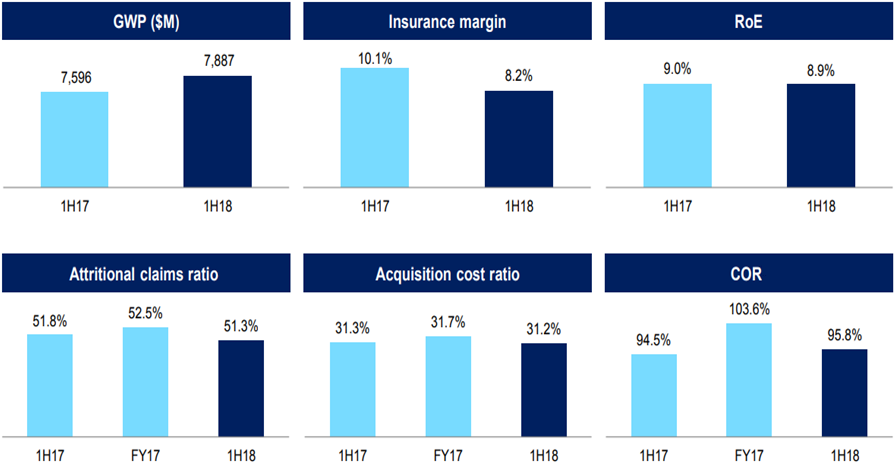
Net profit after tax for the six months ended 30 June rose 4% to US$358 million. Cash profit after tax was up 3% to US$385 million. The bottom line was boosted by robust premium growth, rate increases and fewer adverse weather-related events. The result was ahead of consensus expectations, and saw the shares well bid, with a gain of 7% on the day of the release.
There were a number of positive features in the result, with the first half combined operating ratio (COR) coming in at 95.8%, and within a target ratio range of 95.0% to 97.5%. This as management notes is a ‘meaningful’ improvement on the FY17 COR of 98.2%. The company has guided for FY18 COR of 95.0% to 97.0%.
Source: Company Presentation
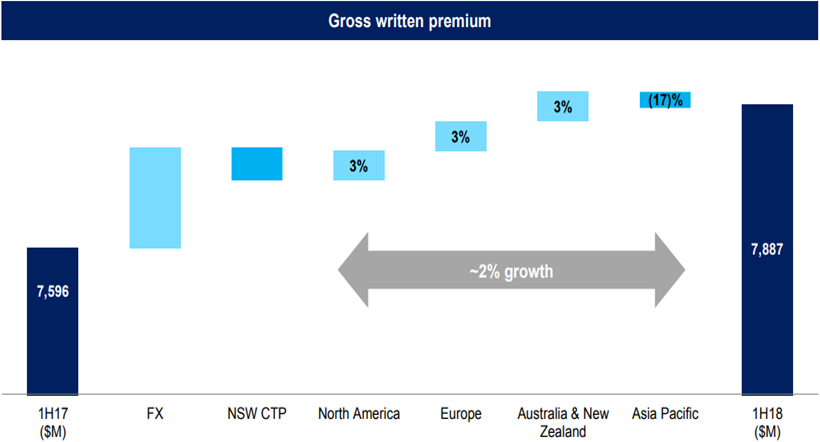
We have been of the view that premiums would likely see significant upward pressure due to last year’s extreme catastrophe experiences. This is also a key aspect of the result. The group achieved an average premium rate increase of 4.6% during the half (compared with 1.0% in the prior period). Gross written premiums rose 1% to US $7.887 billion. Pricing conditions improved in all divisions, but especially in Europe, North America and Asia Pacific.
Source: Company Presentation
Management have been looking to improve the performance of QBE’s business units, and have been conducting ‘Cell Reviews’ across the group. This has already met with some success in lifting performance. Management initiatives to ‘simplify’ the business through the divestment of non-core operations has also helped with the financial outcomes for the group.
Across the divisions, the COR in North America improved to 97.8% from 98.2%, with average premium rate increases of 3.1%, more than triple the prior period. European operations delivered a solid performance, with a COR of 94.5% and average premium rate increases of 4.8% versus a 1.1% decline in the prior period.
In Australia and New Zealand, the COR was stable at 92.3%, while the claims ratio saw a 1.4% improvement. Premium rate increases averaged a very healthy 6.6%. Asia Pacific remains the laggard with the COR improving, but still unprofitable at 108.5%. Having already sold the operation in Thailand, we wouldn’t be surprise to see further divestments within the region to remove a drag on the bottom line.
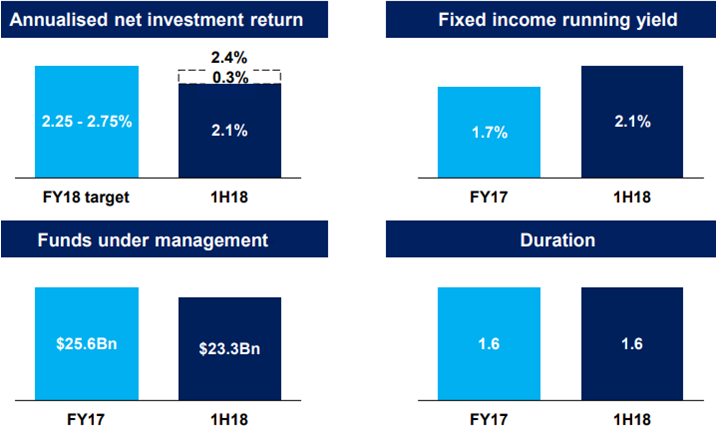
Investment returns were lower than expected at US$287 million in the half, down from US$424 million. This was due in part to mark-to-market losses in the company’s fixed interest portfolio. The annualised net investment return came in at 2.1% versus 3.6% last year. Management are targeting an investment return of 2.25% to 2.75% for FY18. We continue to expect investment income to increase over the long-term on the back of a rising yield curve.
Source: Company Presentation
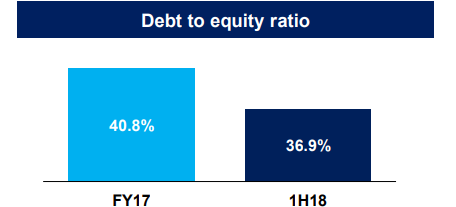
The Board declared an interim dividend of 22 cents per share, in line with last year. Share buybacks have continued and management remain committed to a three-year programme of up to A$1 billion. Robust cash flows have also enabled an improvement in balance sheet strength, with the debt to equity ratio falling from 40.8% at the end of FY17 to 36.9% at 30 June 2018.
Source: Company Presentation
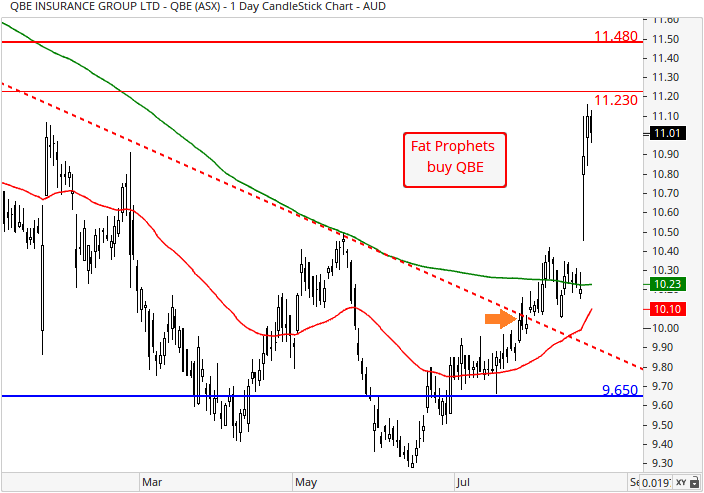
Turning to the charts, and the technical picture has improved somewhat since our last review. Despite a bearish moving average crossover present since August 2017 (when the 50-day moving average (red line) crosses below the 200-day moving average (green line)), prices have gapped higher on the interim result. A sustained break above the 200-day moving average (green line) of $10.23 would bolster the picture further, as would a successful challenge on resistance around $11.23.
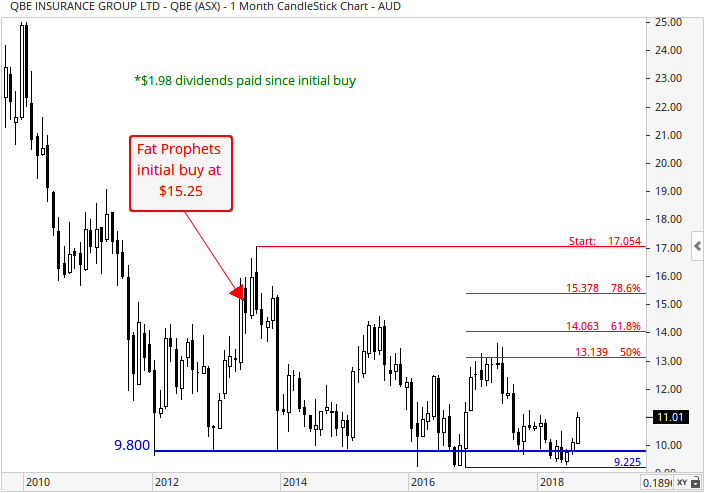
Regarding the monthly chart, a zone of support between $9.23 (November 2016 low) and the psychologically significant $10.00 round number, has held. A further period of price-stabilisation would set the scene for an eventual retest of resistance sighted at the 50% Fibonacci retracement of $13.14 over the broader horizon.
Summary
We have previously said that with sentiment towards QBE at a low ebb (the company reported a net loss after tax of US $1.25 billion in FY17), a low hurdle had been set for sentiment to improve. This is in our view reflected in the reaction to last week’s results.
We have also felt that new CEO Pat Regan would also bring some positivity to the investment story, especially as much ‘kitchen sinking’ has already been done. It seems that the initiatives implemented by management during the half are already yielding benefits. This includes the divestment of businesses that generated an underwriting loss of over US$200 million in 2017.
We see thematic tailwinds also coming through to QBE as premium rates continue to strengthen. A rising yield curve also bodes well for growth in investment income.
We continue to maintain a buy rating on QBE Insurance (ASX:QBE) for Members without exposure.
Disclosure: QBE Insurance (ASX:QBE) is held in the Concentrated Australian Share, Share Income and Small/Mid-cap managed account portfolios
Fat Prophets has made every effort to ensure the reliability of the views and recommendations expressed in the reports published on its websites. Fat Prophets research is based upon information known to us or which was obtained from sources which we believed to be reliable and accurate at time of publication. However, like the markets, we are not perfect. This report is prepared for general information only, and as such, the specific needs, investment objectives or financial situation of any particular user have not been taken into consideration. Individuals should therefore discuss, with their financial planner or advisor, the merits of each recommendation for their own specific circumstances and realise that not all investments will be appropriate for all subscribers. To the extent permitted by law, Fat Prophets and its employees, agents and authorised representatives exclude all liability for any loss or damage (including indirect, special, or consequential loss or damage) arising from the use of, or reliance on, any information within the report whether or not caused by any negligent act or omission. If the law prohibits the exclusion of such liability, Fat Prophets hereby limits its liability, to the extent permitted by law, to the resupply of the said information or the cost of the said resupply.
Funds Management – In addition to the listed funds FPC, FPP and FATP, Fat Prophets Pty Ltd manages the separately managed accounts, namely Concentrated Australian Shares, Australian Shares Income, Small Midcap, Global Opportunities, Mining & resources, Asian Share, European Share and North American Share. These SMAs are managed under their own mandates by the fund managers, and this is independent to the research reports.
Staff trading – Fat Prophets Pty Ltd, its directors, employees and associates of Fat Prophets may hold interests in many ASX-listed Australian companies which may or may not be mentioned or recommended in the Fat Prophets newsletter. These positions may change at any time, without notice. To manage the conflict between personal dealing and newsletter recommendations the directors, employees, and associates of Fat Prophets Pty Ltd cannot knowingly trade in a stock 48 hours either side of a buy or sell recommendation being made in the Fat Prophets newsletter. Staff trades are pre-approved by an appointed staff trading compliance officer to ensure compliance with the staff trading policy.
For positions that directors and/or associates of the Fat Prophets group of companies currently hold in, please click here.
