

Key Market Insights and Stocks Covered This Week
- Washington moved on Wednesday to put a lid on its own borrowing costs. The bond market took it back off inside twenty-four hours – but one kept every basis point.
- We dive into the recent bond market volatility and highlight the implications.
- Three groups in Washington want three things that cannot all be delivered through interest rates. That leaves one variable to absorb the strain – and this week was another confirmation.
- Gold rose on Wednesday as yields fell, then rose again on Thursday as yields reversed. It went up on both.
- The Australian reporting season is in full swing. It split across a few lines. We diagnose.
- Report Spotlight: Evolution Mining – both barrels loaded.
The fatLITE is the weekly read. Membership is the position.
The Verdict
Washington moved this week to put a lid on its own borrowing costs, and the bond market took it back off inside twenty-four hours. On Wednesday, Treasury Secretary Scott Bessent announced he would at least double the size of the Treasury’s buyback operations – the government purchasing its own outstanding bonds back from the market – across the 10- to 30-year maturities. The reaction was immediate and sharp. The 10-year fell 6 basis points to 4.63%, and the 30-year dropped 9bps to 5.19%, retreating from the highest level since 2007. The 2-year barely moved, which told you the market read the operation exactly as it was designed – a targeted intervention on the only part of the curve that had become a political problem. The long end sets mortgage rates and the government’s own interest bill. The US dollar index fell nearly 1% to 98.8, breaking the uptrend in place since the February lows, and gold cleared $4,500 with a 3.3% surge to $4,556.

By Thursday it was effectively all undone. The 10-year and 30-year both added 5bps to 4.70% and 5.24%, with the long bond touching 5.25% intraday. Bessent was back on CNBC dismissing the reversal — “anything that happens within a 24-hour period is noise” — flagging operations that could run beyond $4 billion, against a Treasury market of roughly $40 trillion, commencing in around ten days, and an increased focus on fiscal consolidation to be announced within days. Bond traders spent the session saying “Show me the money!”

Almost everything that moved on Wednesday was given straight back. Bond yields round-tripped. The S&P 500 handed back Wednesday’s gain and more, closing Thursday down 0.87% at 7,641 as Walmart fell 9% on a guidance downgrade and dragged the Dow 1.32% lower. The dollar finished at 98.88, effectively where the intervention left it. What kept every basis point was gold, which even added another 0.75% on Thursday to $4,578, with silver at $68.15 and platinum at $1,840 — all three higher on Wednesday and higher again on Thursday. In our view, the gold market priced the announcement correctly, because gold was the only market pricing something that cannot be taken back. A government can reverse an operation. It cannot un-demonstrate that it was willing to run one. We emphasised this in our Thursday correspondence titled “The Genie is out of the bottle.”
Elsewhere, oil rose again, Brent gaining 2% to $93.40 and WTI to $87.85, with Bessent promising the toughest sanctions in history on Iran. Copper finished around $6.54 after making its high early in the week, and iron ore eased to $95.75. The ASX 200 snapped a six-day losing streak on Thursday to close at 9,083, gold miners doing the heavy lifting.
The failure of the intervention isn’t the main story here. The attempt is. As we see it, the question is not whether Bessent can hold long-term yields down by force – it is that the US Treasury has now demonstrated a willingness to respond the moment market pricing threatens a broader policy objective, and that changes the calculation for anyone shorting the long end. Foreign holdings of Treasuries fell $72.1 billion in June, with Japan and China posting the largest declines and three falls in four months now establishing a trend. Someone is selling in size, and Washington has shown it will step in. The next fortnight brings the sanctions detail, the fiscal consolidation announcement, the first buyback operations and Kevin Warsh at Jackson Hole. We suspect the market is underestimating what is coming.
The Calls
“I don’t see the US10yr breaking above 5%. There is a determination at the US Treasury to see the 10yr bond yield contained below this risk threshold. The market therefore might be underestimating Scott Bessent’s coming operations and intervention that could be very successful near term. Longer term and looking ahead several years, I hold a very different view and see US bonds in a secular bear market that could endure for years.”
Near term: the 10-year holds below 5%
We see two supportive factors. The MOVE index, which prices volatility in the bond market like the VIX does in equities, has remained remarkably low and range-bound even with the 30-year pressing multi-decade highs. That is not the reading you would expect from a market bracing for a large-scale Treasury operation. At the same time, hedge funds have crowded into steepener trades – betting the gap between short-term and long-term yields keeps widening. The bases are loaded. If intervention arrives at scale, and Bessent has just told the market it may exceed $4 billion and begin within ten days, that positioning gets caught badly offside and the unwind will be violent. It is also worth noting who is running this. Bessent spent years working with Soros and ran his own fund; Kevin Warsh came out of Morgan Stanley. Both were picked personally by the President, and it is unlikely these two are not speaking daily. This is not an academic Treasury, but one with financial market experience.

Longer term: a secular bear market in bonds
We see US bonds in a secular bear market that could run five to ten years. The mechanism is the part that much market commentary has skipped. The buybacks are funded through bill issuance, which means long-dated debt is being replaced with short-dated paper – Operation Twist, run by the Treasury rather than the Fed. That shortens the debt profile – short-dated paper has to be refinanced sooner, at whatever rate prevails then – and raises the interest rate sensitivity of a $40 trillion pile on which servicing costs are already running above $1 trillion a year. In our view, Washington is buying near-term relief by making the structure more fragile. Meanwhile, the underlying pressure is building below the surface. Foreign holdings of Treasuries fell $72.1 billion in June against a $9.3 trillion total, Japan down $26.4 billion to $1.12 trillion and China down $25.9 billion to $633.4 billion, the third decline in four months. Regardless of where rates go from here in the short term, we have little doubt the Fed eventually prints money simply to service the interest.
The dollar to take the strain
The dollar is where the adjustment lands. We wrote last week that the White House wants lower borrowing costs into November, the Treasury wants the 10-year below 5%, and the Fed wants inflation under 2% – three objectives that cannot all be delivered through rates, leaving the currency as the only variable all three offices can afford. The late-July yen operation was the first proof. This week’s bond intervention is the second, and the DXY breaking its February uptrend is the tape agreeing. For Australian investors, a softer greenback normally means a firmer Australian dollar, which held at US71.1c on Thursday. The offset sits in resources, where a weaker dollar lifts commodity prices – BHP (ASX: BHP) and Rio Tinto (ASX: RIO) remain our preferred large-cap expressions, and we expect the commodity move to outrun the currency effect.
Gold shines again
Our conviction on gold has strengthened, and the reason has changed. Through most of this year, gold traded inversely to real yields – the return a bond pays after inflation. Gold pays no income, so when bonds deliver a strong real return, gold looks expensive to hold. That relationship hasn’t held this week. Gold rose 3.3% on Wednesday as yields fell, then rose again on Thursday as yields reversed – it went up on both. The dollar wasn’t acting like just a rates trade. It is, increasingly, a trade on the creditworthiness and the printing behaviour of the issuer, and that is why the $4,500 breakout matters more than the move that produced it. Gold has rebounded strongly in August. The buying is institutional and official – central banks and sovereign wealth funds, with physical bars still clearing at a premium to spot in Asian hubs, China in particular.
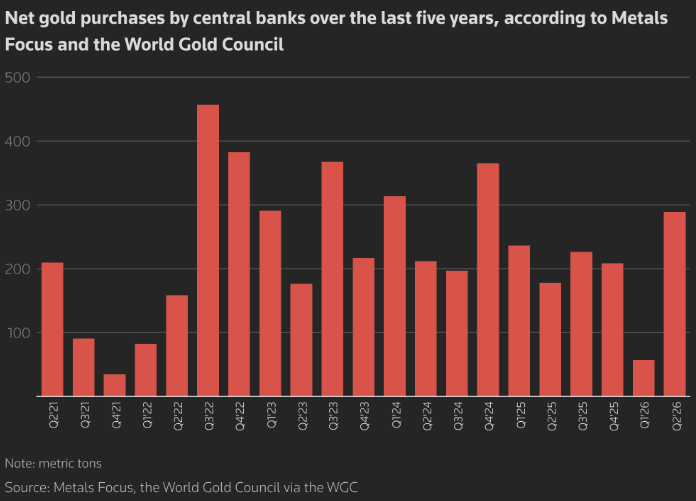
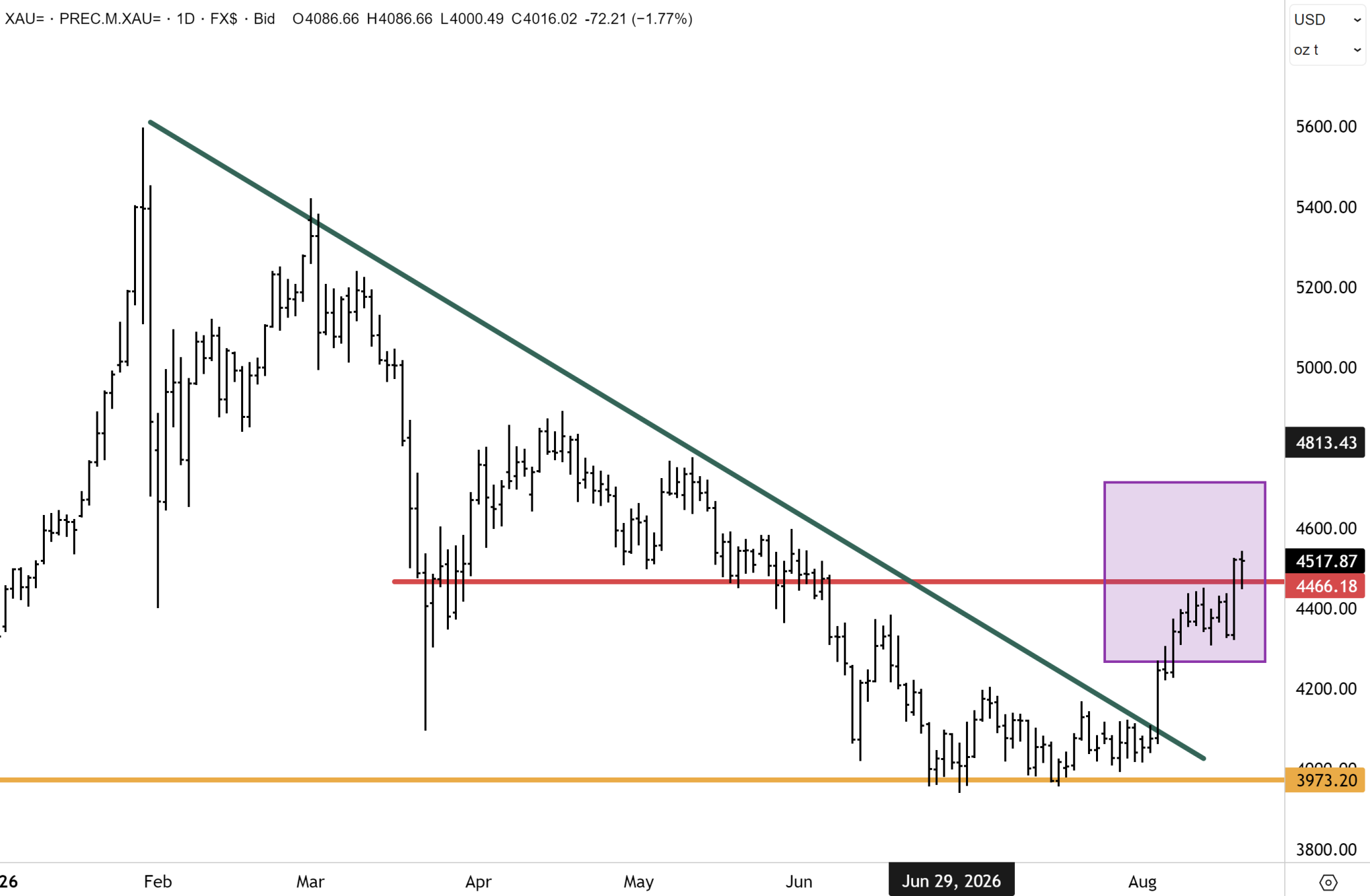
A $5,000 handle by December is certainly back on the cards. Gold’s breakout above the key resistance cluster at $4,500 is sending a signal that the bull market in precious metals is reasserting. Someone in size is back on the open spot market buying physical gold. All roads lead back to the central banks, and China in particular.
Locally, this lands on the gold miners, and the earnings in this area over the past week have been impressive and generally well-received. Northern Star (ASX: NST) and Evolution Mining (ASX: EVN) are covered in the Report Spotlight. Silver and platinum are confirming the same inflection. Silver at $68.15 and platinum’s breakout above $1,800 to $1,840 both point to the corrective phase that began in February being complete, with upward momentum resuming behind gold.
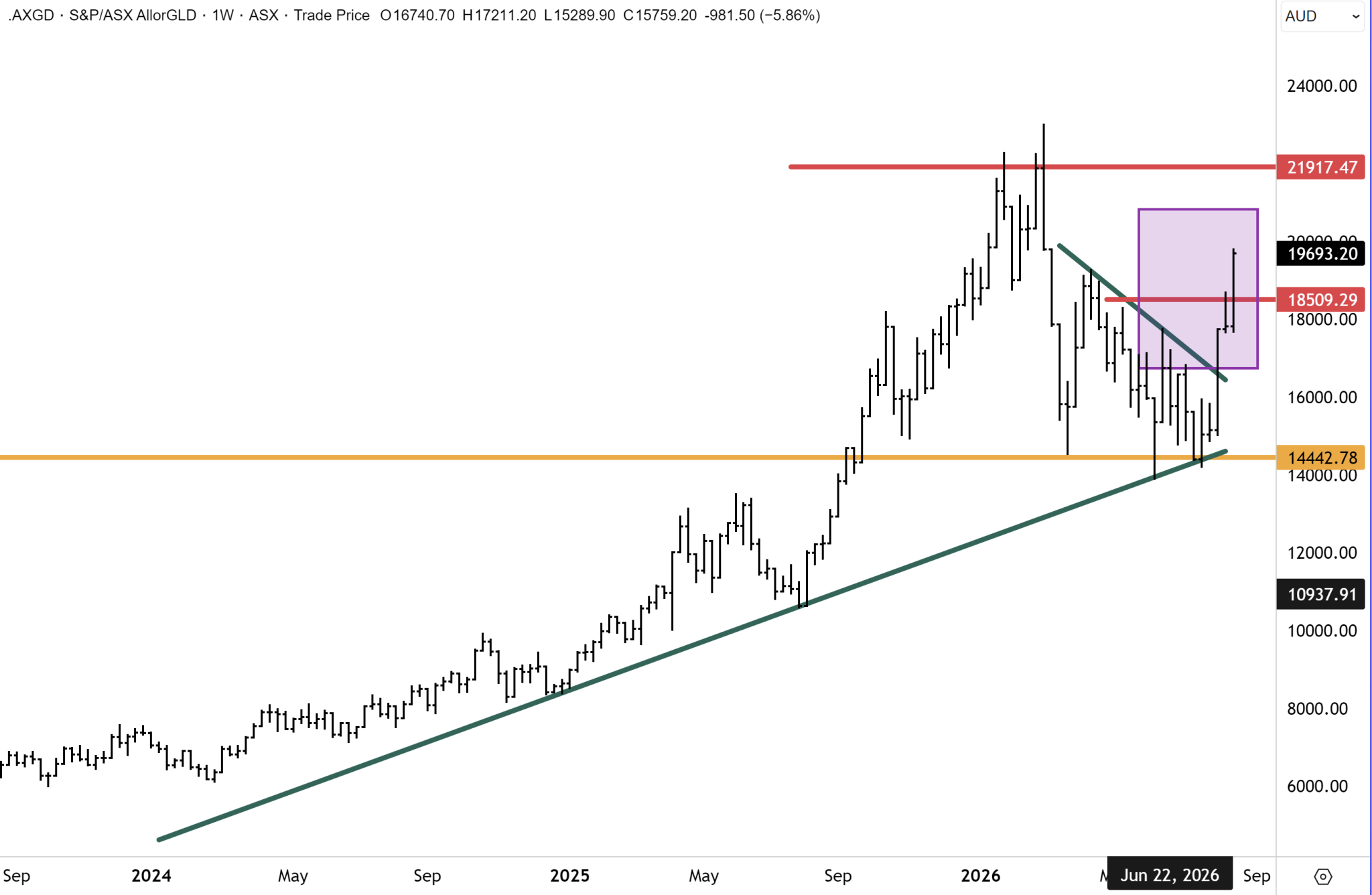
The All Ordinaries Gold index has broken out above key resistance in recent weeks as the bull market in Australian gold miners reasserts. We believe the record highs for the index near 22,000 will be retested by December if spot gold maintains upward momentum to $5000oz – which is our base case. Australian gold miners have reported some of the strongest earnings results in the current reporting season, which is underpinning momentum.
The Local
We are taking the other side of market pricing on the RBA’s rate path. Futures still lean toward a hike by year-end. Thursday’s labour data went the other way – unemployment ticked up to 4.5% from 4.4% against forecasts for no change, and employment fell 15,800 against expectations for a 12,000 gain, with part-time roles down 32,200. The Wage Price Index is running at 3.2%, the slowest in around eighteen months, with private sector wages at a multi-year low of 3.1%. With the housing market under pressure and three hikes already delivered this year, we do not think this RBA hikes into rising unemployment and a cooling housing market.
This week was one of the busiest in the reporting season, and results will continue to flow through thick and fast next week. While dispersion was wide, specific stocks largely moved on actual results and outlooks; there were a few key takeaways. On Monday, JB Hi-Fi (ASX: JBH) fell 12.3% on a full-year result that lifted both revenue and earnings to fresh highs. Nothing in the delivered numbers was wrong. The market fixed on a fourth quarter where trading softened enough to miss what analysts had pencilled in, and marked the stock down accordingly. Over the past week, Discretionary had lost more than 6%, ranking it as the worst performer amongst the broad sectors.
On Tuesday, CSL (ASX: CSL) rose 17.25% on a result that carried a headline loss. The market looked past it to management guiding to around 5% profit growth next year, ahead of forecasts. This was a classic example of the market not paying for what companies earned, but what is likely ahead – more on CSL later. Pro Medicus and Cochlear also reported well-received results. On Friday at the time of writing, the sector was up more than 8% over the past week and easily the top performer locally among the 11 broad sectors.
In the same postcode, up more than 8% over the past week, was the All Ordinaries Gold Index. Yes, bullion prices rallied, but earnings are now also doing hard work, and this showed through in results. Evolution Mining, Newmont, Northern Star, Ora Banda, Regis Resources, Genesis Minerals, Vault Minerals and St Barbara all rallied, among others.
Energy chugged along, logging modest but steady gains throughout the week, including at lunchtime on Friday. This was largely because of the lift in oil prices, but Santos and Whitehaven were among those that advanced following results.
The banks were a drag, and the headwind was a structural artefact caused by rate hikes and the tax changes in the federal budget. National Australia Bank (ASX: NAB) set the tone on Monday, falling 4.6% after disclosing home loan applications down 15% since the May budget, even with third-quarter profit up 2% to $1.83 billion and a CET1 ratio of 11.93%. The majors have now put a similar number in front of the market, and it has stopped being treated as a one-off.
Report Spotlight
Evolution Mining (ASX: EVN) – Buy
Evolution is now fully unhedged on both its primary metals (gold and copper) following its last gold hedge deliveries in FY26, so price moves flow straight to cash flow. FY26 cash flow rose 76% to A$1,389m, flipping the balance sheet from A$849m net debt to A$19m net cash, even while investing heavily and generously returning capital. The dividend payout target was lifted to 60%, and the full-year dividend jumped 62% to 41 cents. Production dipped on Cloncurry rainfall disruption at Ernest Henry, and costs rose, but metal price strength more than offset both. FY27 spending steps up 26%, weighted toward growth projects.
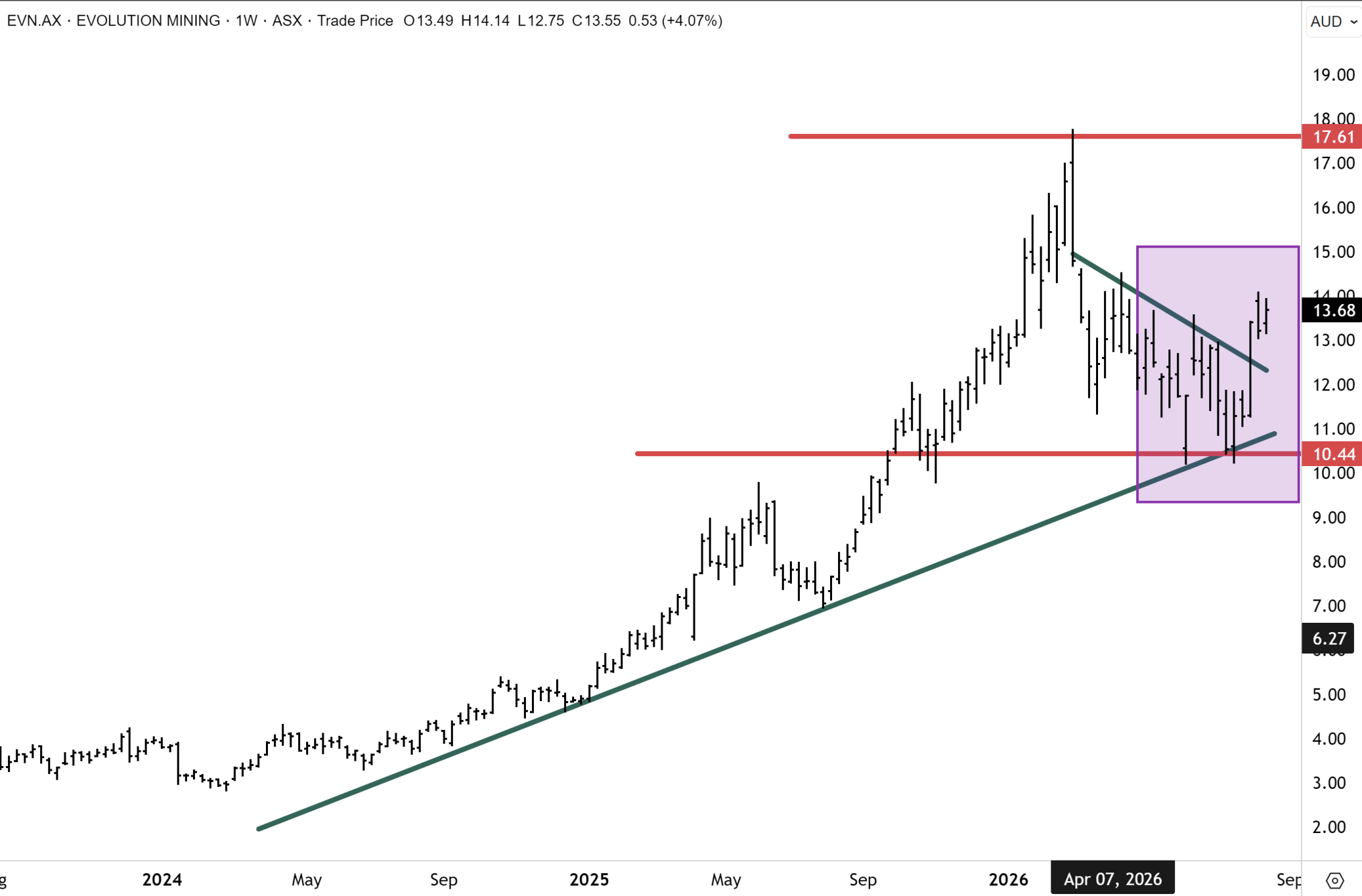
Since our last update, upward momentum in Evolution has reasserted, which is consistent with the inflection in spot gold and copper making new record highs. During the recent shakeout and consolidation, EVN managed to hold above and fully respect the primary uptrend. The shares have recently confirmed a topside breakout above the downtrend and are now extending higher given the renewed upward momentum in gold and copper. Resistance is clustered above $15, but we expect this to be cleared over the coming year and for the record highs near $18 to be retested.
Everything in this fatLITE is the surface. The full reports, macro commentary, model portfolio, and buy recommendations are members-only. Try it with our 30-day money-back guarantee.
Have a great weekend.
Carpe Diem
Angus

