

- Last week the Treasury doubled its bond buybacks to hold long yields down, and this week the bond market spent four sessions largely ignoring it. Stanley Druckenmiller, who worked alongside Scott Bessent with Soros in the 1990s, took the decision apart in the Wall Street Journal – and his argument goes to what happens when the last real check on government borrowing is quietened.
- Gold has found support at the two-year uptrend, and we now hold conviction it reclaims $5,000 by year-end. Three catalysts are driving it, and one is strengthening faster than the others.
- The yen sits at the centre of the world’s financial plumbing, and one of Australia’s largest super funds has just made a very large bet on it.
- Household spending came in at roughly triple the forecast, and both NAB and CBA pulled forward their calls for a fourth rate hike.
- Report Spotlight: An ASX-listed stock we just upgraded to a BUY.
The fatLITE is the weekly read. Membership is the position.
The Verdict
The US Treasury said last week that it would double the maximum size of its bond buyback operations to at least $4bn – buying back its own long-dated bonds from investors, pushing their price up and their yield down. The debt those bonds belong to passed $40 trillion this month. This week brought a debate over that decision from a source that carries much market weight. Investors also had more opportunities to ‘cast their vote’ through their trades. We see big implications across bonds, FX and equity markets.
Yields fell sharply on Tuesday, but they fell because oil dropped around 5% – cheaper energy means less inflation ahead, so bondholders demand less compensation for it – rather than anything the Treasury did. Oil was back on the radar as a key driver of long-dated yields. Then the annual PCE inflation gauge came in hotter than expected at 3.7%, and yields rose on Thursday across the 2-year, 10-year and 30-year to 4.23%, 4.67% and 5.19%. This type of activity is the market pricing fundamentals, in the first full week after the Treasury tried to convince it not to, highlighting how this typically doesn’t last long.

Pushback on the Treasury move arrived early and from an interesting source. Stanley Druckenmiller took the Treasury’s decision apart in the Wall Street Journal. He worked alongside Scott Bessent with Soros in the 1990s, and is one of the most respected investors of the past 40 years, which gives the criticism a heavier weight than any think tank.
His case is that the long-term Treasury yield is the most consequential price in the world and the only fiscal disciplinarian the US has left. When investors lose confidence in the borrowing, they demand a higher yield, and that rising cost is what forces a government to rein in its spending. In Druckenmiller’s reading, the recent surge in the 10-year was a market that had been a pushover finally beginning to clear its throat, and the Treasury moved to quiet even that.
Intervention has worked before. Japan held its curve down for years, and the Plaza Accord in 1985 moved the dollar 40%. Both were undertaken from fiscal strength. Not the monster debt pile that the US has now accumulated.
The rest of the tape was largely unremarkable this week, consistent with an intervention that didn’t do much. The S&P 500 rose 0.72% on Thursday to around 7,731, carried by Nvidia, which surged nearly 9% on revenue of $96.2bn against $92.2bn expected and is now again the largest US (and world’s) market cap company at $5 trillion. The results highlight the AI rollout continues to get bigger. Meanwhile, Salesforce added 22% on raised guidance, its best session in six years, and we continue to see evidence that the sell-off in quality SaaS on AI fears has been overdone. This is relevant for WiseTech and Xero, listed in Australia.
The ASX 200 fell 0.98% on Thursday to 9,038 and, at the time of writing on Friday afternoon Sydney time, was up ~0.5% and flattish over the past week. On Thursday, gold slipped from above $4,700 to $4,658, but has rallied over the past week. Copper was flat at $6.69, near record levels. Oil fell more than 6% on reports of a shipping framework through the Strait of Hormuz, then recovered part of that decline to $83.60 as the mine clearance was disputed. Silver jumped 2% on Thursday to $70.15. The Bloomberg Commodity Index closed at 140, testing multi-year highs. The Australian dollar was around US72c as local rate-hike expectations built after an elevated CPI print was followed by strong household spending data.
The Calls
The Treasury is buying back long-dated bonds and replacing them with short-dated bills. Long bonds tie money up for decades, and investors demand a higher yield for taking that duration risk; short paper does not. Swap one for the other and yields on the 10-year and 30-year come down. It does not reduce a dollar of the debt. What it does instead, as noted in our correspondence this week, is shift the risk onto the United States itself. A debt stack rolled shorter has to be refinanced sooner and reprices more quickly if yields rise.
Washington wants to avoid a disorderly unwind in the Treasury market at a time when Japanese investors hold around $1.2 trillion of the paper, while the stated objective is to lower long-term financing costs. Those are real objectives. Ray Dalio’s arithmetic illustrates the scale of the problem they are trying to address: revenue of around $5.5 trillion against $7.5 trillion of spending, interest costs alone of around $1 trillion this year, and roughly $10 trillion of debt to refinance.
History shows a different normal. The 10-year currently yields above 4.6%. Across the past 75 years, it has averaged closer to 5% to 6%. The decade in which it fell to 0.5% is the outlier, not today’s level.
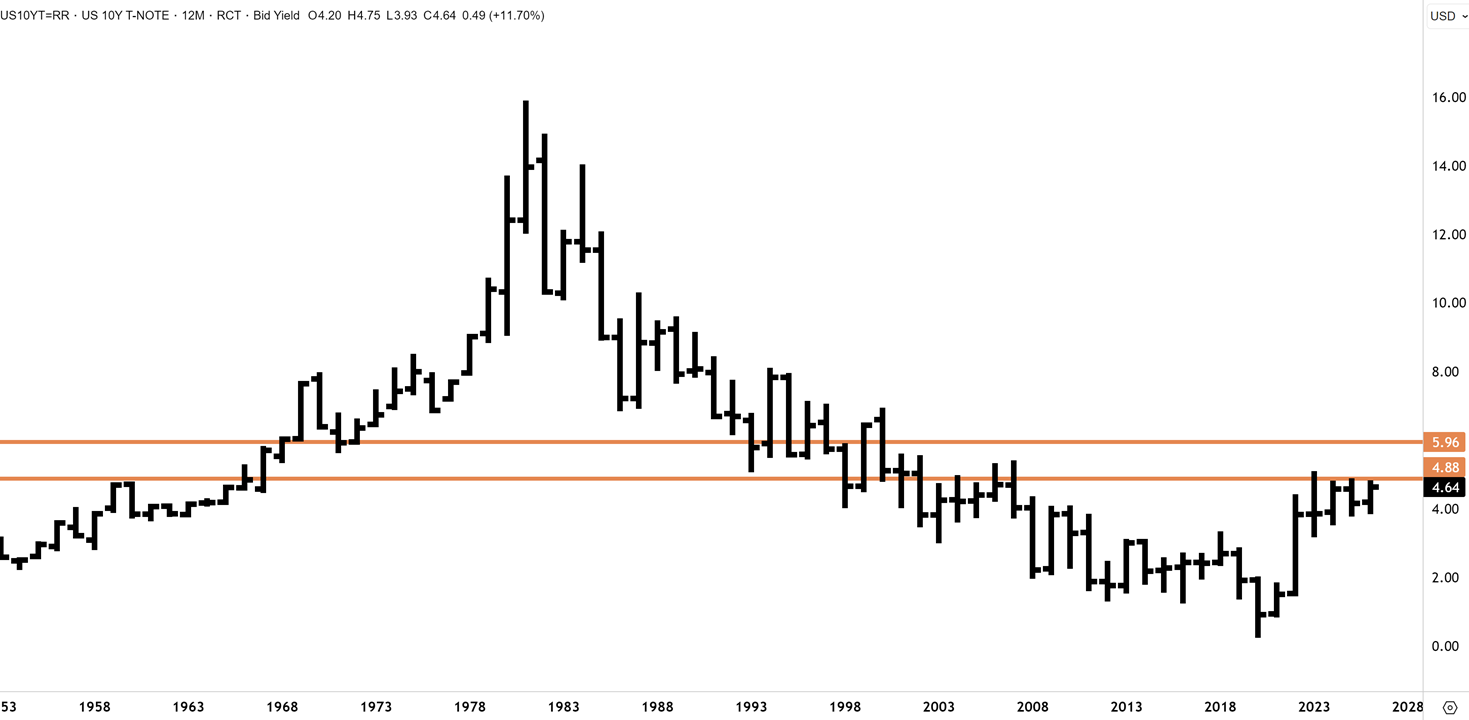

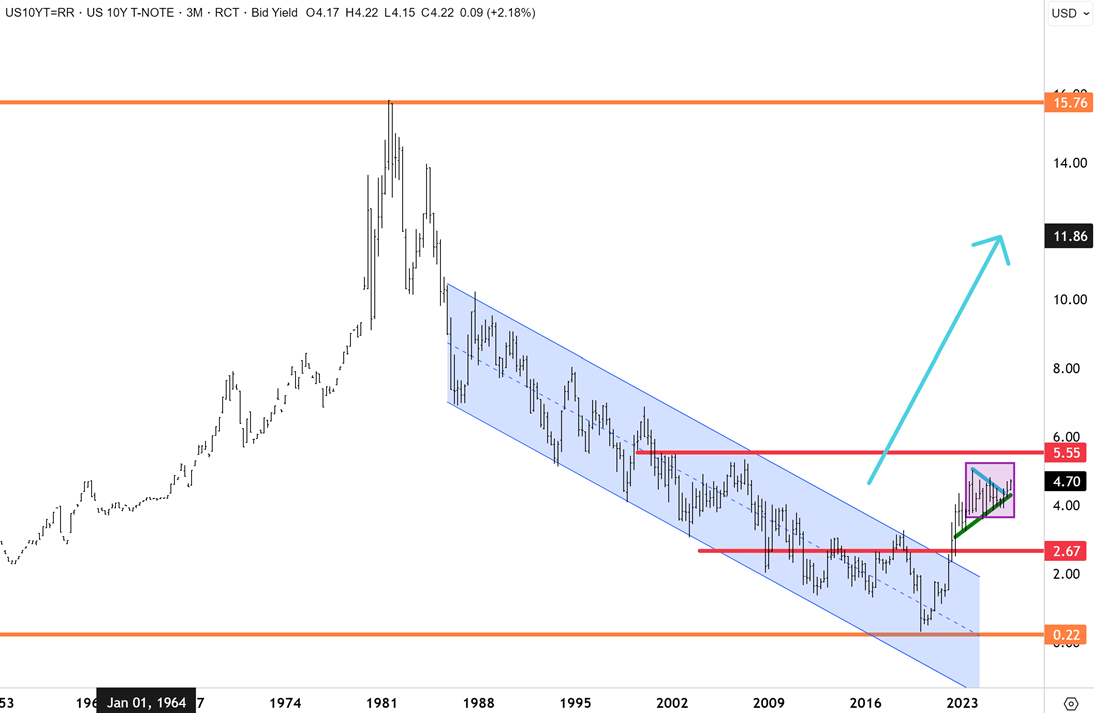
I also agree with Ray Dalio’s call that investors should reduce exposure to longer-dated bonds. For some time now, we have been vocal about the US and global markets in a longer-term bearish cycle that could run for 10 to 20 years. Ray Dalio holds a similar view and believes a US debt crisis will arrive and is possibly just three years away. In a LinkedIn post published on Friday, the billionaire fund manager said investors should diversify across assets and countries with strong finances.
The US bond market is in an early stage of a new secular bear market in my view. Next year the 10yr will likely finish the year with a 5.5% – 6% handle on it.
The rise in gold over recent weeks partially reflects consternation amongst investors about where that path is headed. As written in the daily this week, “The real deep-seated fear is that the US government will at some stage resort to outright money printing at some point to control rates. This fear is well founded in my view, but I have to emphasise this outcome is not imminent and just around the corner, but a scenario that could play out over the next five to ten years.”
Gold found support at the two-year trendline in place since 2024. We believe the correction that began at the February highs is now complete and that upward momentum is reasserting. We have conviction that gold is on track to reclaim the key $5,000 level by year-end.
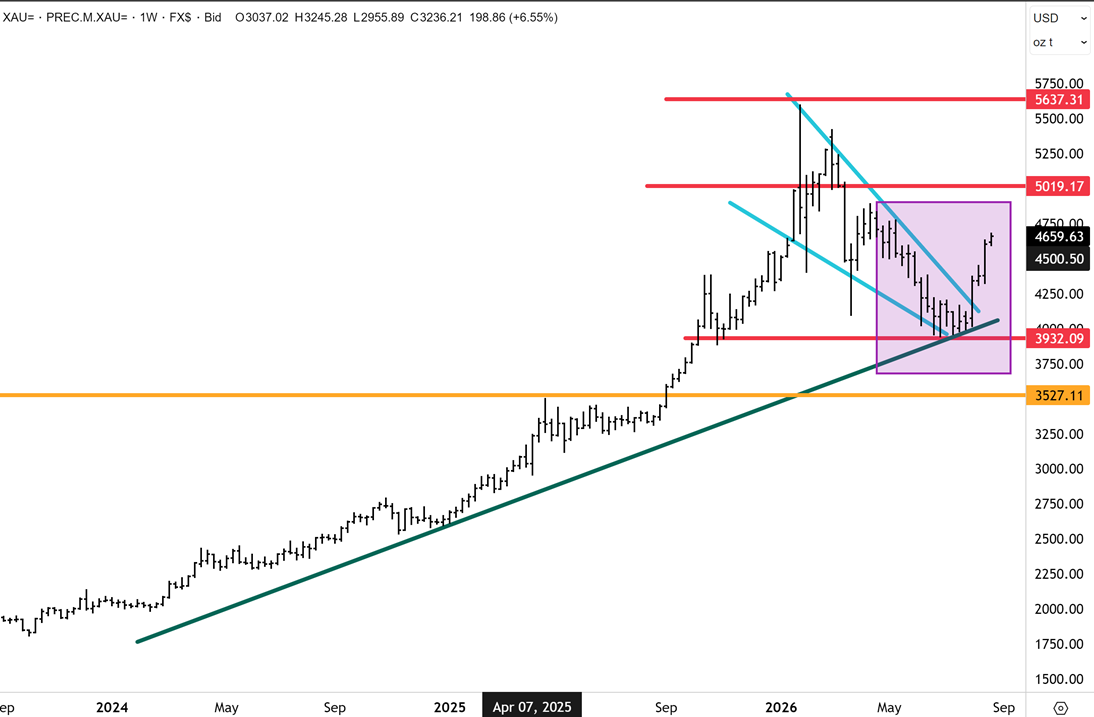
We outlined three catalysts. The US Treasury intervention in the FX market and selling of euros against the yen provided the market with a wake-up call. The intervention by the US government pointed to growing discomfort with rising Treasury yields at the long end of the curve, where the 30yr made two-decade highs. The second catalyst arrived last week with the US Treasury announcing further plans to intervene in the bond market and manipulate the yield curve. The third catalyst has been the re-emergence of central bank buying, which is outweighing some residual selling at the margin by Russia and Iran that badly need foreign currency. We see this last catalyst as developing the fastest.
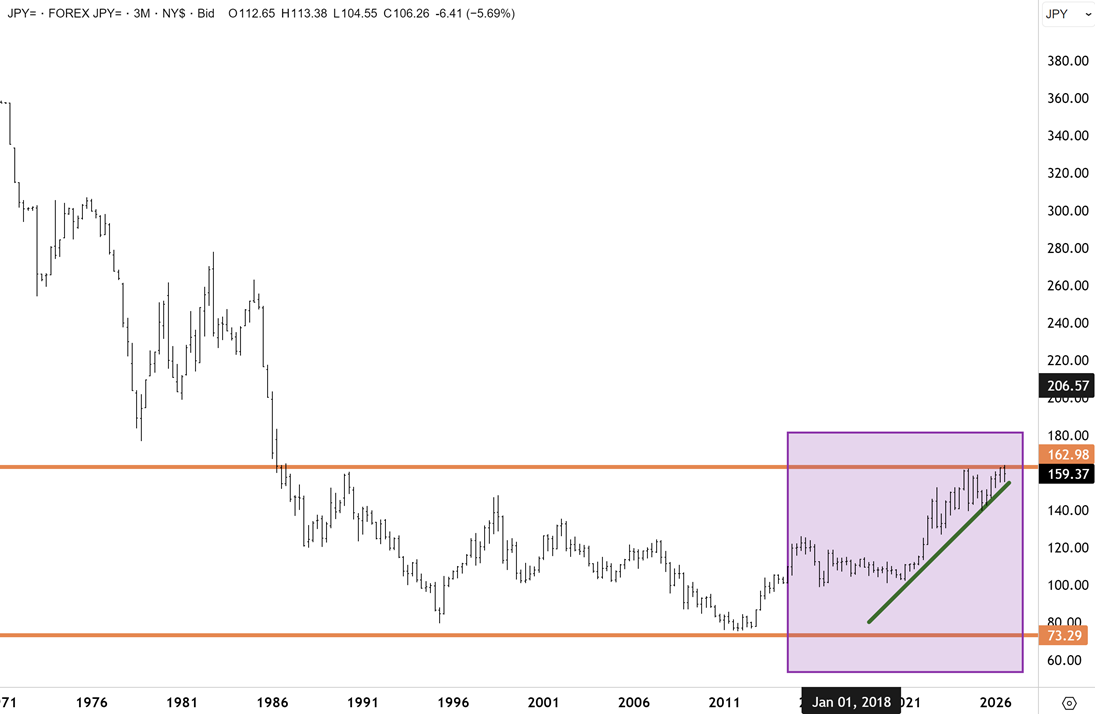
The yen is hugely important in the world’s financial plumbing, and there has been a lot going on. The US Treasury has intervened, selling euros against it, and read alongside the buyback, the logic is that rising Japanese yields exert a pull on the US bond market, and with Japanese investors holding that $1.2 trillion, relieving the pull means pushing dollar/yen lower. We have held a bullish yen view for a while now. Swaps now price around an 80% chance of a Bank of Japan hike in September and a move fully by October, with room for the cash rate to reach 1.25% and for the Bank to signal more.
The Australian Retirement Trust has taken the same side. According to a report out on Bloomberg, Australia’s second-largest superannuation fund has built its biggest overweight position in the Japanese yen in years, in a bet that markets are under-pricing and underestimating the Bank of Japan’s determination to hike interest rates to head off a surge of inflation. The Australian Retirement Trust, which manages about $370 billion of savings, has spent the past six months adding to its long yen position as the dollar/yen FX rate rose above Y160. According to senior portfolio manager Jimmy Louca, this is part funded by trimming long exposure to the greenback.
Taking a large bet of this size in FX markets is a relatively rare move by Australian long-only superfunds and goes against the prevailing disposition of the hedge fund industry, which is still quite short yen and long dollars.
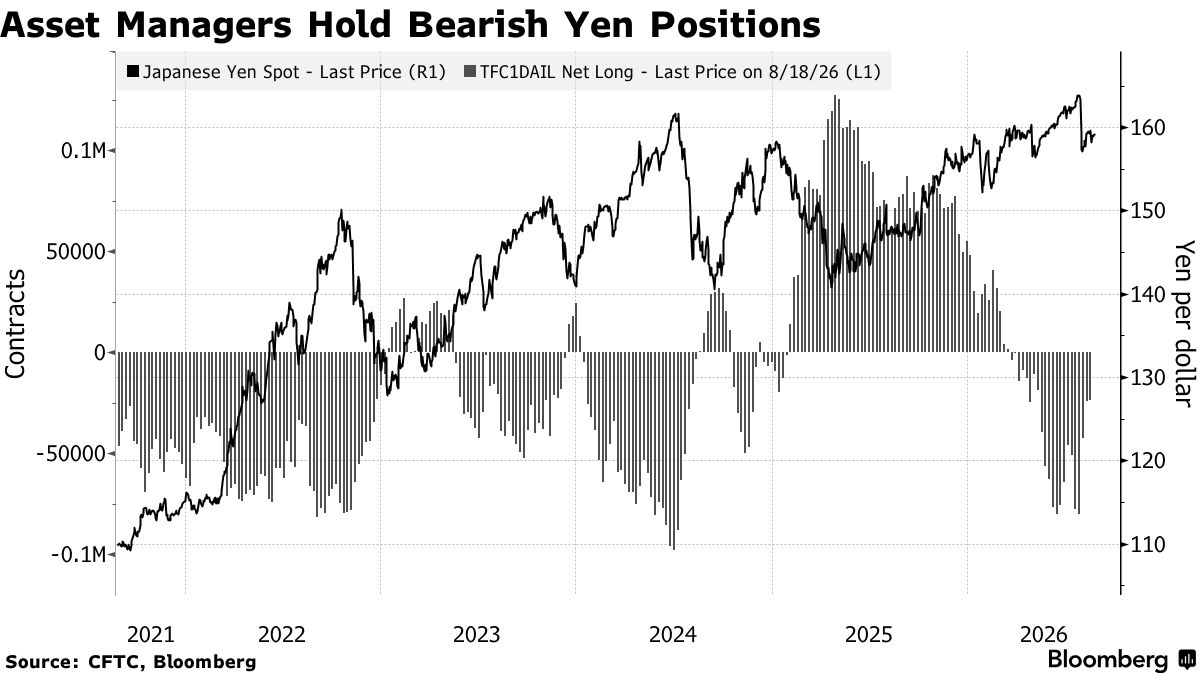
In 2024, there was an unruly unwind when the yen carry trade triggered an avalanche of short covering that induced a three-day 25% flash crash in the Japanese stock market. I don’t think the same outcome will happen again, because the BOJ has strongly signalled to the markets its intention to tighten monetary policy and lift rates.
I also agree with Mr Louca’s bullish bet on the yen – and would not want to be short the currency and overly long dollars – which in my view is headed towards another cyclical decline over the coming months. The dollar/yen rate hit a 40-year high last month as traders bet the BOJ will be slow to raise rates while energy costs stay elevated. Mr Louca told Bloomberg that he thinks the market only got part of it right and the drag from higher energy prices is already priced in, but the odds of BOJ rate hikes still look too low.
The dollar/yen has moved up to the top of the historical trading range that extends all the way back to 1986.
The Local
Australia’s July headline inflation print eased to 3.5% from 3.8%, which is progress, but far from the drop to 3.3% that economists were forecasting. The trimmed mean, the gauge the Reserve Bank actually watches, held at 3.6% against a 3.5% forecast and marked the equal strongest annual pace in almost two years. Thursday then brought household spending up 1.1% for the month, roughly triple the forecast, with all nine major categories advancing and the annual pace accelerating to 7%, the fastest since mid-2023. Given the soft job market and the visible cracks in housing, it is surprising how much Australian households are spending.
The response was rapid. NAB moved its call for a 4th hike this year to September and CBA to November. Money markets now price roughly even odds for September, with a November move priced as close to certain if the Bank holds off next month.
The ASX 200 drifted over the week with the rises and falls largely cancelling one another out. Reporting season continued to throw up plenty of dispersion. When it was all said and done, materials has been the strongest performer over the past week locally, up around +2.5%, followed by staples +0.9%. Real estate -4.3% and discretionary -4% faced the most pain, with a lot of that linked to the macroeconomic data discussed above.
The pattern is that the market paid for composition and guidance rather than for headline profit, and it worked in both directions. Financials settled this week, but after a lot of pain earlier in August.
Report Spotlight
Genesis Minerals (ASX: GMD) – Buy
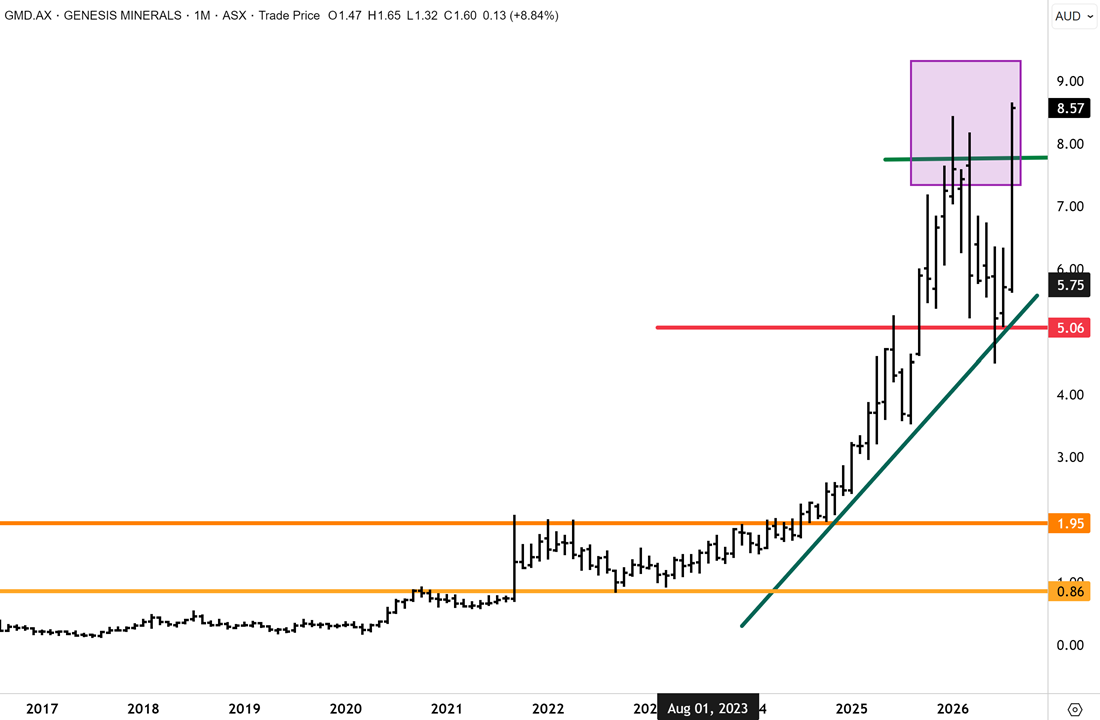
We upgraded Genesis Minerals to Buy. We think the earlier gold consolidation has run its course. Treasury intervention at the long end, buybacks of longer-dated paper in the week US debt passed US$40 trillion, and accelerating central bank buying led by China point us to US$5,000 an ounce by year-end. Genesis is fully unhedged from 1 October, with reserves struck at A$2,800 an ounce against an A$ gold price more than double. FY26 realised A$6,009 against an AISC (all-in sustaining costs) of A$2,670, a margin of A$3,339. The Vault merger seals it. Roughly A$700 million of mill spending is set to be removed, and management has flagged up to A$2.0 billion of long-term financial benefits, along with higher-cost ounces (from Vault) that will provide more torque to a higher gold price. Management has a superb track record.
Since our last update, upward momentum has dynamically reasserted in Genesis Minerals, with the shares breaking through to new record highs above $8.50. We believe support is well defined at $8 and $7 below. The breakout points to new record highs ensuing over coming months, with spot gold also reasserting upward momentum.
Everything in this fatLITE is the surface. The full reports, macro commentary, model portfolio, and buy recommendations are members-only. Try it with our 30-day money-back guarantee.
The full, more detailed versions of all these reports and many others spanning Australasia, Mining and Global Equities are available online for your reading pleasure. Links to the different landing areas for Members are at the bottom of the FatWrap.
Have a great weekend.
Carpe Diem
Angus

