

Key Market Insights and Stocks Covered This Week
- The US 10-year broke through 5%. Our near-term call didn’t hold. Here’s where we stand now.
- Hedge funds are heavily short long-dated bonds.
- US and Iranian negotiators are reportedly working on a phased reopening of the Strait. What this could mean for markets next week.
- Money markets now price a 70% chance of an October Fed hike. We see a different timetable.
- Australian unemployment rose to 4.6% ahead of Tuesday’s near-certain RBA hike. Why we doubt the hikes that the market has priced in after it.
- Free this week: our September research note on St Barbara (ASX: SBM) and a spotlight on James Hardie Industries (ASX/NYSE: JHX).
The fatLITE is the weekly read. Membership is the position.
Fat Prophets Platinum, our full service, for $695 a year until midnight Monday 28 September. Join at $695.
The Verdict
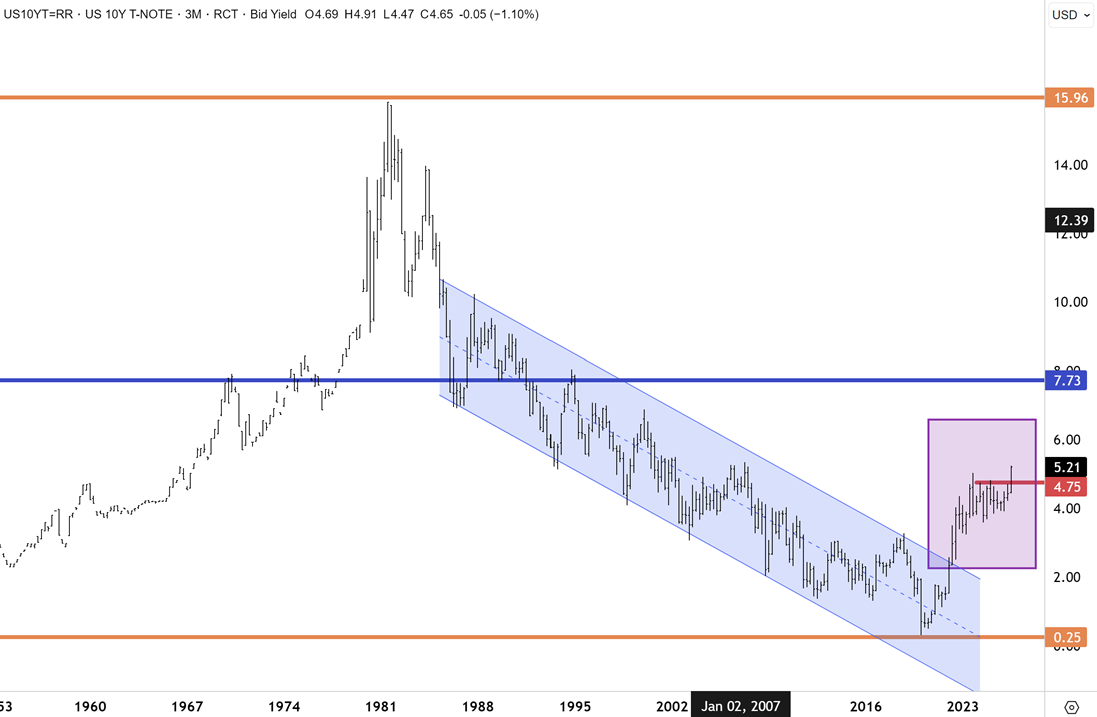
We began the week expecting the US 10-year yield to hold below 5% in the near term, on falling oil and hopes of a deal with Iran. That held early week. On Wednesday, Iran’s president told the UN that Tehran would never surrender to the US under pressure, oil rose, and the 10-year broke through 5%. It closed Thursday at 5.21%, with the 30-year at 5.48%, its highest since 2004. Our near-term call on the 10-year did not hold.
Our view is that the move has gone too far. We believe this week’s selloff in the bond market will prove to be excessive if the geopolitics around the ME changes and an agreement is reached. We are therefore likely seeing peak yields across the US curve in this phase and for the rest of 2026. Next year is going to be a different story, but for now, bond markets have priced in a worst-case scenario. Our longer-term view is unchanged. Fixed income is in a secular bear market, and yields are likely to move higher again from 2027.
Equities took the selloff resiliently. The S&P 500 closed Thursday at 7,704, down marginally from 7,764 on Monday, and the benchmark trades just under 19 times forward earnings, its cheapest level since 2023.
The view stands on the peak-yields call above, and a deal to reopen the Strait would bring yields down quickly. Our base case of a strong finish into year-end is unchanged, with the September-quarter reporting season now a few weeks away, when we expect another strong US earnings season, following up on Q2.
Oil remains the swing factor. Reports on Friday morning that US and Iranian negotiators are exploring a phased reopening of the Strait, with Washington lifting its blockade of Iranian ports, point to the upside risk. We expect the Fed to skip October and treat December as the live meeting. In Australia, we think the further increases priced beyond next Tuesday’s RBA hike, which is almost certainly in the bag here, would prove excessive. We differ from many in the market here.
The Calls
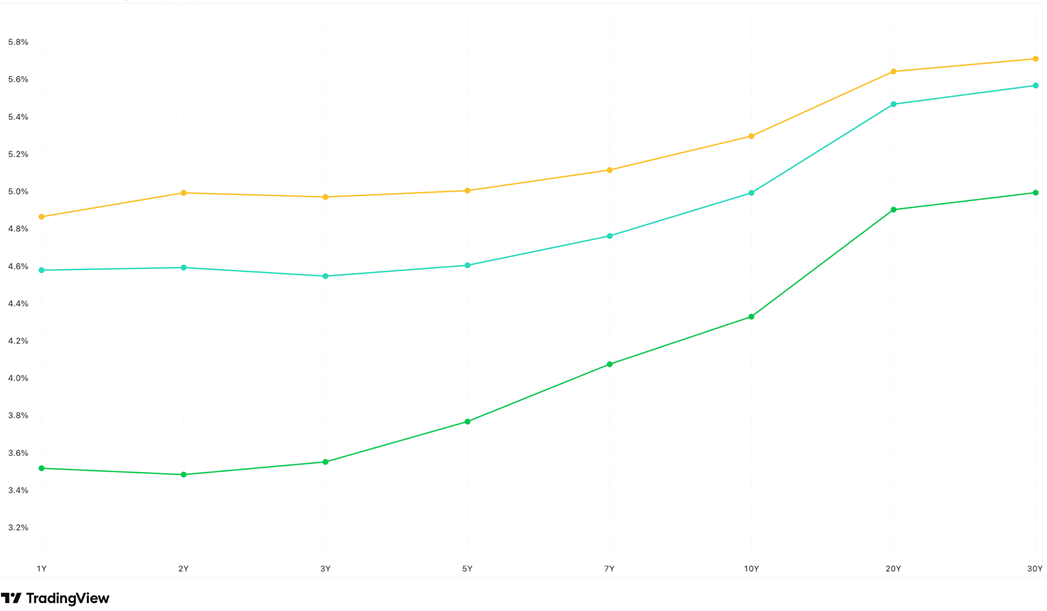
The bond market set the tone this week. The US 10-year rose from 4.95% on Monday to 5.21% on Thursday, the 30-year from 5.28% to 5.48%, and the two-year from 4.75% to 4.93%. Wednesday did much of the damage. Iran’s defiant UN address lifted oil, and the S&P Global flash US composite PMI rose to 58.4, with input prices growing at the fastest pace since 2022 and a pickup in wages noted by many firms. Fed Governor Michael Barr said further hikes would likely be needed. Money markets now price a 70% chance of an October increase, up from 50% on Monday, and the two-year implies three to four more hikes.
The bond selloff was global. Germany’s 10-year Bund yield reached 3.579%, its highest since 2009; 10-year gilt yields rose to 5.37%, the highest since 2007, and the 10-year JGB yield rose to 3.075%, its highest since August 1996. Norway’s Norges Bank raised rates for the second time this year and flagged another increase. The relatively old-school composition of the FTSE 100 has seen it prove resilient amid recent volatility, holding a +7.5% advance YTD at the close on Thursday.
A trick for young players is thinking the absolute levels we are seeing are elevated, but in the overall scheme of things, the US10yr yield above 5.2% is not out of sorts as it relates to history and when the bond has traded over the past 45 years. However, the move higher in the 10yr yield this year now looks quite overextended. Near term, the global bond market seems significantly oversold. A downside reversal in US and global bond yields could therefore be swift, given hedge funds and financial institutions are now ultra-short the long end of the curve and now too exposed to shorter-term rates.

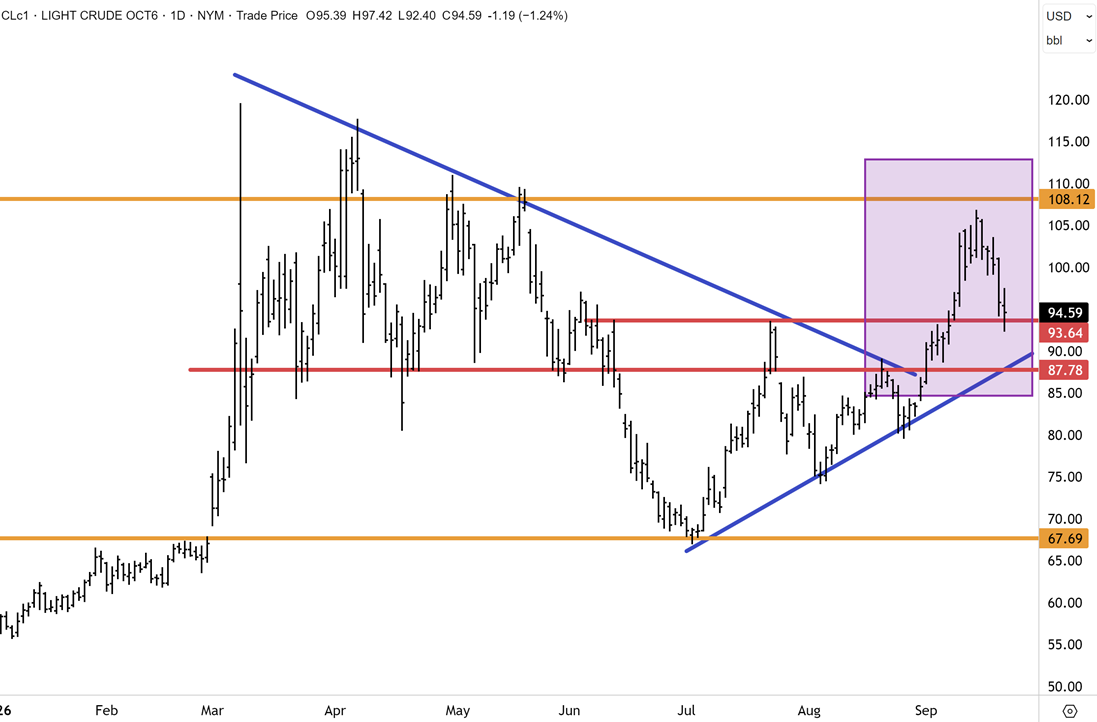
Oil was choppy. WTI fell from its September peak above $108 to $94.59 on Tuesday, after Saudi Arabia restarted its East-West Pipeline and President Trump described a three-hour meeting with Iranian envoys in New York as “very productive”. It rose again after Wednesday’s UN address and closed Thursday at $94.87. The technical setup for WTI still skews bullish, and only a sustained break below $90 reverses the narrative.
We still expect a deal. The Gulf states have urged Washington to avoid further escalation, as the disruption to traffic through the Strait slows their own economies, and China, Saudi Arabia, Qatar, the UAE and Pakistan have all pushed publicly for an end to the conflict. Qatari officials are reported to be mediating the phased talks. At the UN, President Trump said he believes Iran will make a deal after the US midterms on 3 November. We think it could come sooner, with affordability the dominant issue for voters. A phased reopening of the Strait coming soon could deliver a significant upside surprise for financial markets next week.
The JP Morgan trading desk made a point we agree with. The Fed is hiking for the right reasons, which makes it a question of sector selection within equities rather than a reason to underweight stocks.
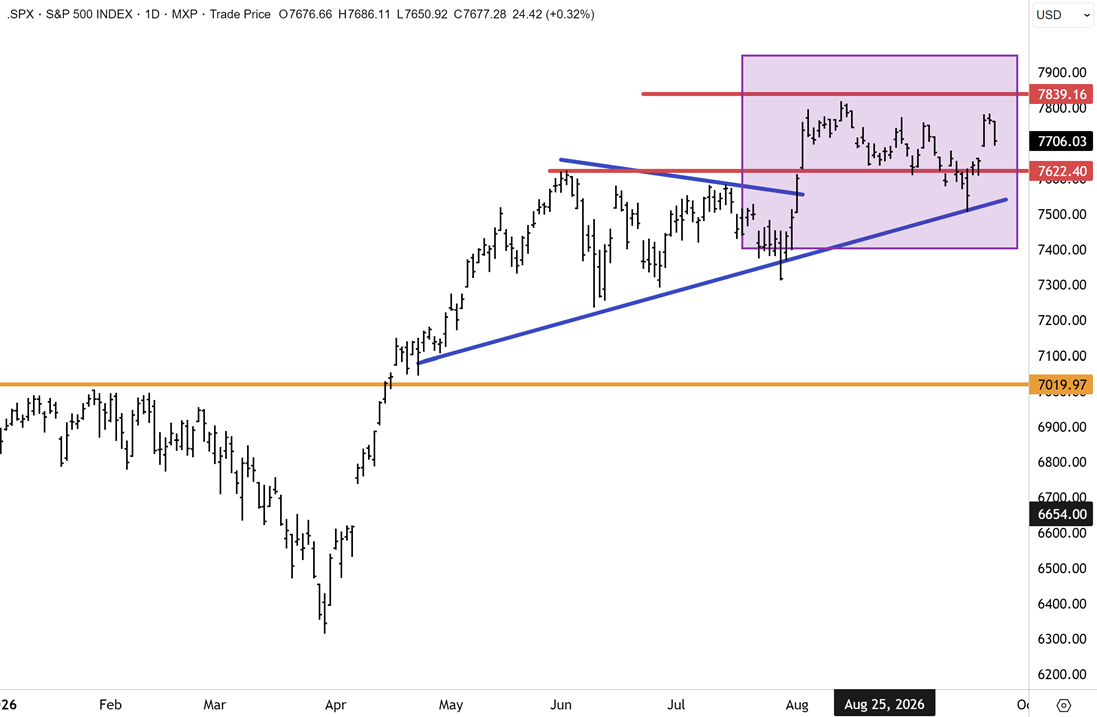
Stocks held up well, really. Given the higher base in the yield curve, the stock market is less sensitive to rates, and the Fed will have less room to chop in terms of tightening monetary policy. Morgan Stanley’s Mike Wilson kept his 8,000 year-end target for the S&P 500, “driven by earnings resiliency”, while flagging 7,000 to 7,100 as a tactical downside case over the next three to five weeks if oil and midterm risks emerge. Near-term support resides at 7,600, and if broken on the downside, the SPX could sustain a deeper near-term correction towards the uptrend at 7,500.
For a deeper +10% SPX correction to play out over the next five weeks where the index fell towards 7,000, it would take stronger negative catalysts. Under that scenario, we would need to see reescalation in the ME, broadening attacks on key infrastructure, oil prices moving north of $120 and another rise in the US yield curve (10yr approaching 5.3% to 5.5%). The Fed would also need to deliver another hawkish rate hike in October and flag more to come. This is still a low-probability scenario in my view, given the MT elections are approaching and where most US citizens will decide based on the economy and where there is a clear domestic and international imperative for the WH to now make some concessions and wrap the war up. Time will soon tell.
Political gridlock after the midterms, historically well received by markets, looks plausible. Many investors are positioned bearish and defensive, and cash has built up on the sidelines.
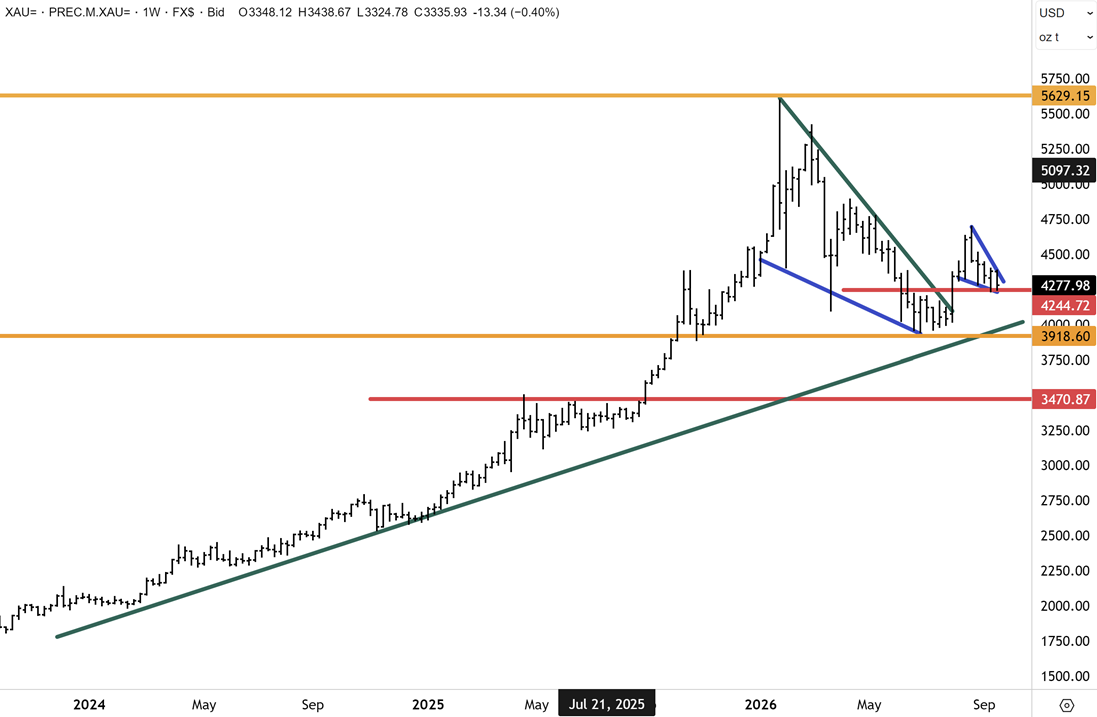
Gold eased from $4,380 on Monday to $4,306 on Thursday, but held up through the bond rout and a stronger dollar. Treasury Secretary Bessent’s threat to use the dollar system against countries trading with Iran could be a decisive factor in pushing gold up to our December target of $5,000/oz, as central bank buying resumes in earnest. Gundlach said he resumed buying gold when it fell to $4,000. The formation developing on the weekly chart of gold below mirrors what occurred between the February peak at $5,600 and the early June low just above $3,900. Whilst it’s always difficult to determine a floor, I think gold is close. Downside momentum is dissipating, and support is being found in a higher range. A topside breakout above the near-term downtrend would point to topside momentum resuming.
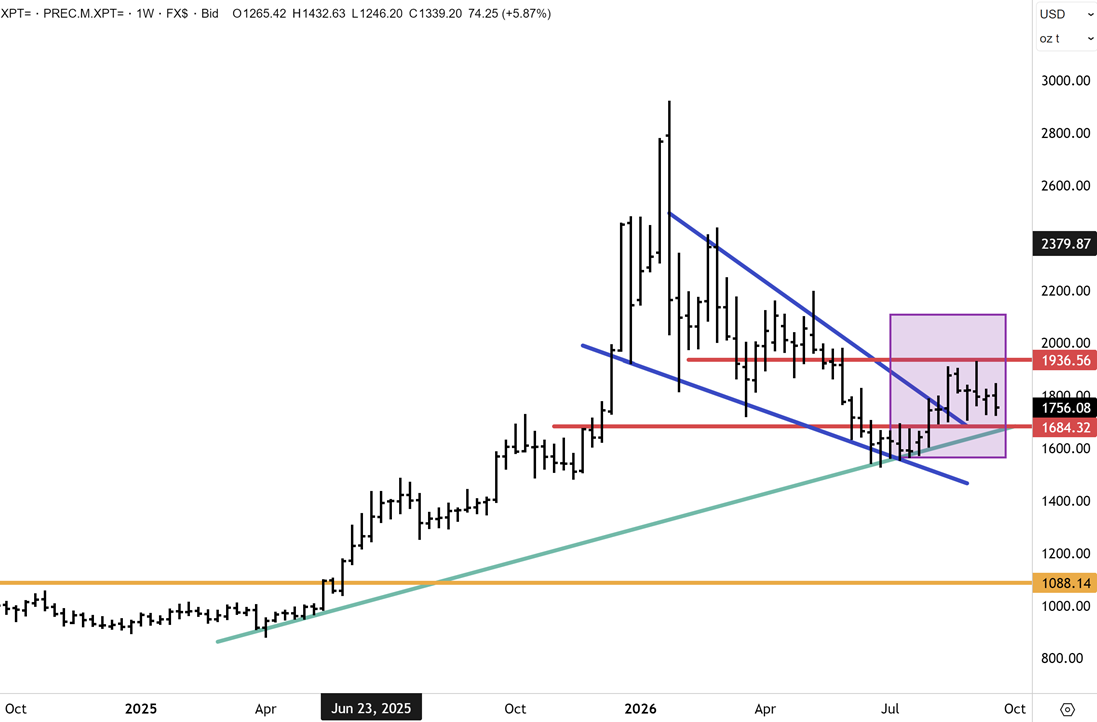
Platinum is following a similar path. Platinum bottomed at a similar time to gold at around $1,600. A new base of support is being traced out in a higher range. A topside breakout above $1,900 would be a strong sign of upward momentum resuming and platinum embarking on another bullish phase.
See what our members get. For a gold idea on the ASX, here is our September research note on St Barbara (ASX: SBM), free for fatLITE readers.
- St Barbara has agreed to sell a mine but keep a royalty over it, so it keeps a share of the upside without the operating costs.
- The market has priced the sale. Our note looks at what it hasn’t properly priced yet: the project behind the next stage of growth.
- We also set out the risks.
Members get research like this as it is published. As a fatLITE reader, you can join Fat Prophets Platinum, our full service covering Australian and international stocks, mining and resources, and the daily fatCHAT, for $695 a year until midnight Monday 28 September. Join at $695.
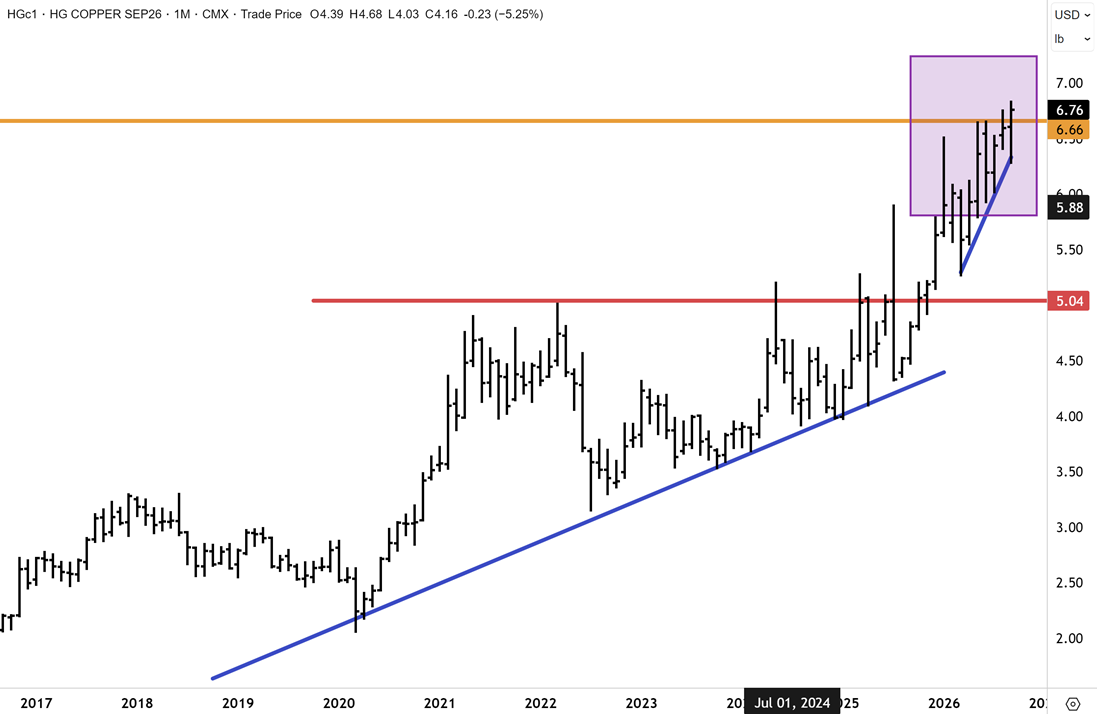
Copper hit a record high on Tuesday, with Comex up 2% to $6.90 a pound and LME at $14,660 a tonne, before easing to $6.77 by Thursday. Chinese demand has returned. The Yangshan premium rose to US$121 a tonne, its highest in almost four years, and Chinese warehouse stocks fell to 54,780 tonnes, the lowest since January 2024.
In terms of the technical setup for copper, the pattern screens bullish. Each successive pullback in Comex copper has established a higher low. Meanwhile, topside resistance above the highs near $6.60 has been repeatedly tested and probed by traders. The pattern favours a topside breakout above $6.70 and upside extension to north of $7 over the coming months. Watch for copper miners to move in lockstep.
The Local
The ASX 200 fell 0.42% on Friday to 8,665. Staples, up 0.7%, and financials, up 0.3%, were the only sectors to rise on the day, with the banks up 0.85% driving the broader financial sector. Tech fell 1.7% and discretionary 1.4%. The banks’ gain followed a Thursday session in which the financials sector closed near a multi-month low, and the real estate sector was at its weakest level in over two years. The Australian 10-year yield rose to 5.37%, a multi-year high. Small caps lagged again, with the Small Ordinaries down 1.4% on Friday, as they tend to be more sensitive to interest rates. But for contrarian and patient investors, the number of bargains in the sector is growing.
A 25bp increase to 4.6% at Tuesday’s RBA meeting is all but certain. CBA brought its forecast forward from November, so every major bank economics team is now expecting a September hike, and futures lean towards 4.85% early next year. Governor Bullock said an unemployment rate of 4.5% to 5.0% would probably remove enough heat from the labour market, and the RBA has retired its “narrow path” language about preserving employment gains.
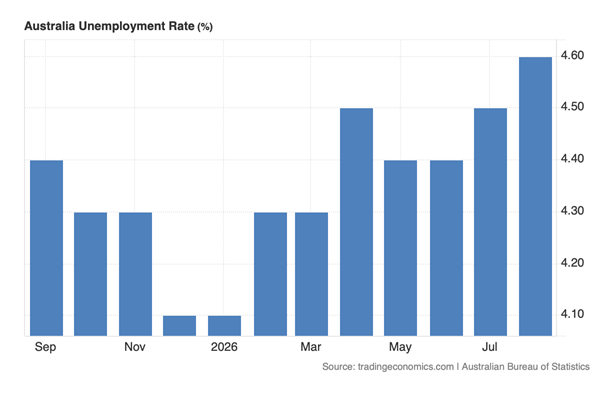
August unemployment rose to 4.6%, above the 4.5% forecast and the highest since November 2021, even though employment grew by 39,500 against expectations of 20,000. Part-time roles accounted for all of the gain, with full-time jobs down 6,300, and participation rose to 67.1%. The flash manufacturing PMI fell to 49.3 in September, its first contraction since March.
What is different to the US is the fact that Australia’s economy is slowing and buckling after multiple rate hikes this year, a tanking residential housing market, and rapidly dissipating consumer confidence.
The unemployment rate at 4.6% is concerning, and I believe this key gauge could have a 5 in front of it by the 1st or 2nd quarter of next year. The RBA could well be cutting rates by then. A cooling labour market, along with weaker housing (that has yet to hit a bottom), strengthens the case that the further rate hikes just about every economist now expects will not eventuate. Real Estate, the banks and growth stocks are set to benefit in that scenario.
Canberra’s borrowing costs are rising with yields. Treasurer Jim Chalmers has warned that the mid-year budget update will show billions of dollars in extra interest costs, on top of a forecast $64.1 billion deficit this financial year. RBC Capital Markets estimates the rise in yields since May could add about $6 billion to federal interest costs over four years, beyond the $146.3 billion already budgeted. Gross federal debt is above $1 trillion, material for an economy of Australia’s size but not onerous at about 34% of GDP. Australia’s comparatively strong public finances offer comfort, but every additional dollar spent servicing debt buys no additional public services.
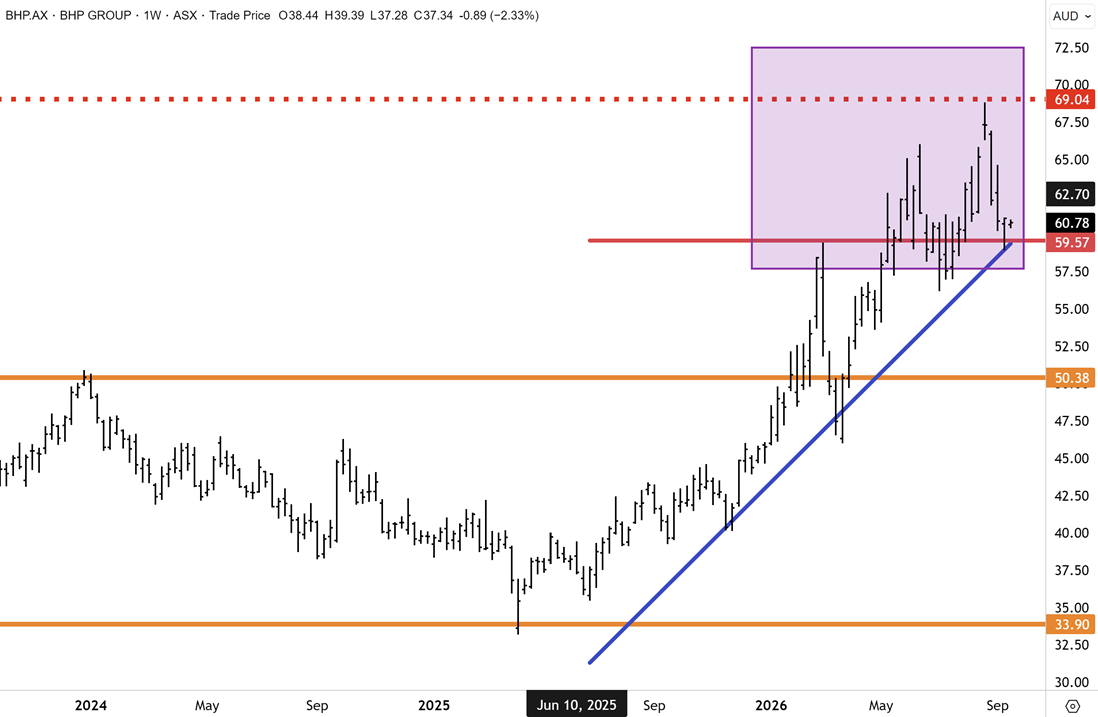
Copper remains our preferred base metal. We like pure plays like Sandfire and Capstone, while BHP and Rio Tinto are well positioned as two of the world’s largest copper miners, and Evolution now earns a nice chunk of cash from copper. Over 50% of BHP’s underlying earnings now come from copper, and if copper goes well above $8 to $9 a pound, BHP could carry a $100 handle.
BHP has corrected back to $60 after touching $69 for the first time in August. Support should now be found at $60 and below, before upward momentum likely reasserts itself in conjunction with a stronger copper market.
Next week, attention turns to the RBA decision on Tuesday, the outcome of the Trump–Xi summit and any confirmation of progress on reopening the Strait.
Report Spotlight
James Hardie (ASX/NYSE: JHX) – BUY
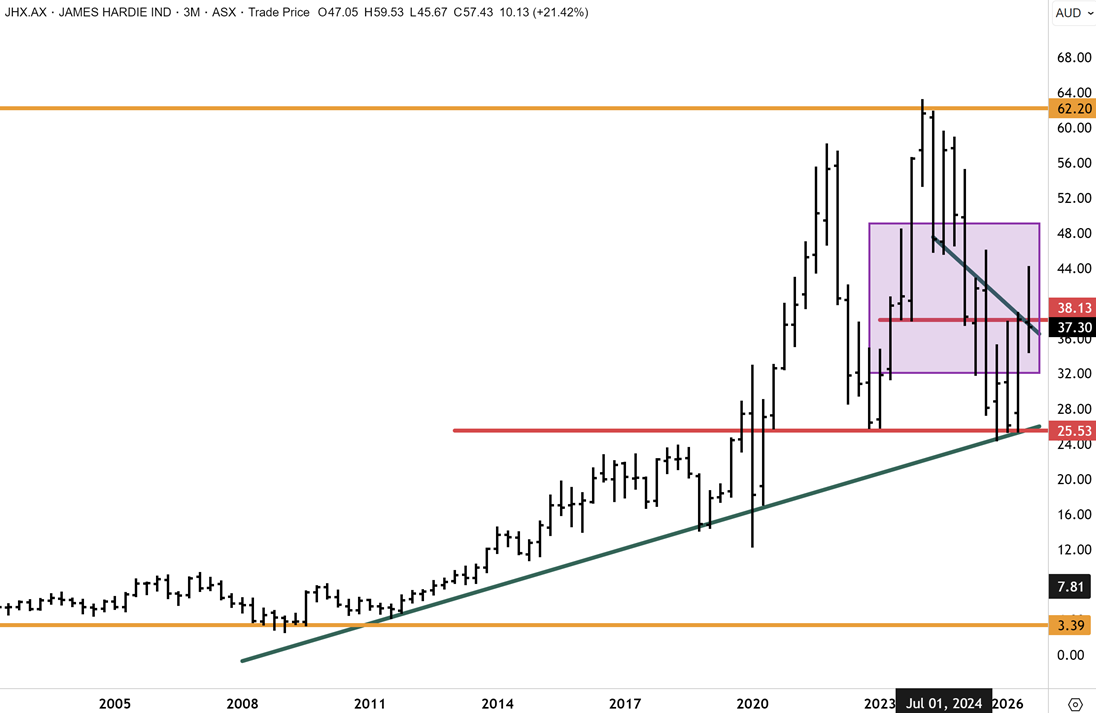
James Hardie raised its FY27 free cash flow target to US$600m-plus at the New York investor day, but the shares fell. Sales and EBITDA guidance were reaffirmed rather than raised. Much of the extra cash comes from AZEK deal costs rolling off, not from the business generating more, but cash is cash. The investment case is intact. The US$125m cost-synergy target is arriving a year early. About US$600m of the ~US$980m Fermacell sale proceeds will go to paying down debt, and leverage should fall from 2.7x to below 2x by Q2 FY28. The forecasts don’t assume a US housing recovery. Instead, they rely on fibre cement taking share from older siding products across a large, ageing US housing stock. At ~11.8x forward EV/EBITDA, we continue to see value for those looking through the cycle.
Thank you for reading fatLITE. We value you as a reader, so here is an offer for you: Fat Prophets Platinum, our full service covering Australian and international stocks, mining and resources, and the daily fatCHAT, for $695 a year until midnight Monday 28 September. Join at $695.
Have a great weekend.
Carpe Diem!
Angus

