

- The ASX hit a five-month high with all eleven sectors green – then nine gave back the next day. What broke the run.
- The US 30-year touched 5.24% – highest since 2007 – and the curve steepened from the wrong end. Why that distinction decides what you do with duration.
- Copper fell 0.7% on the day the KOSPI hit its eighth circuit breaker of the year. A conviction we’d take from this week.
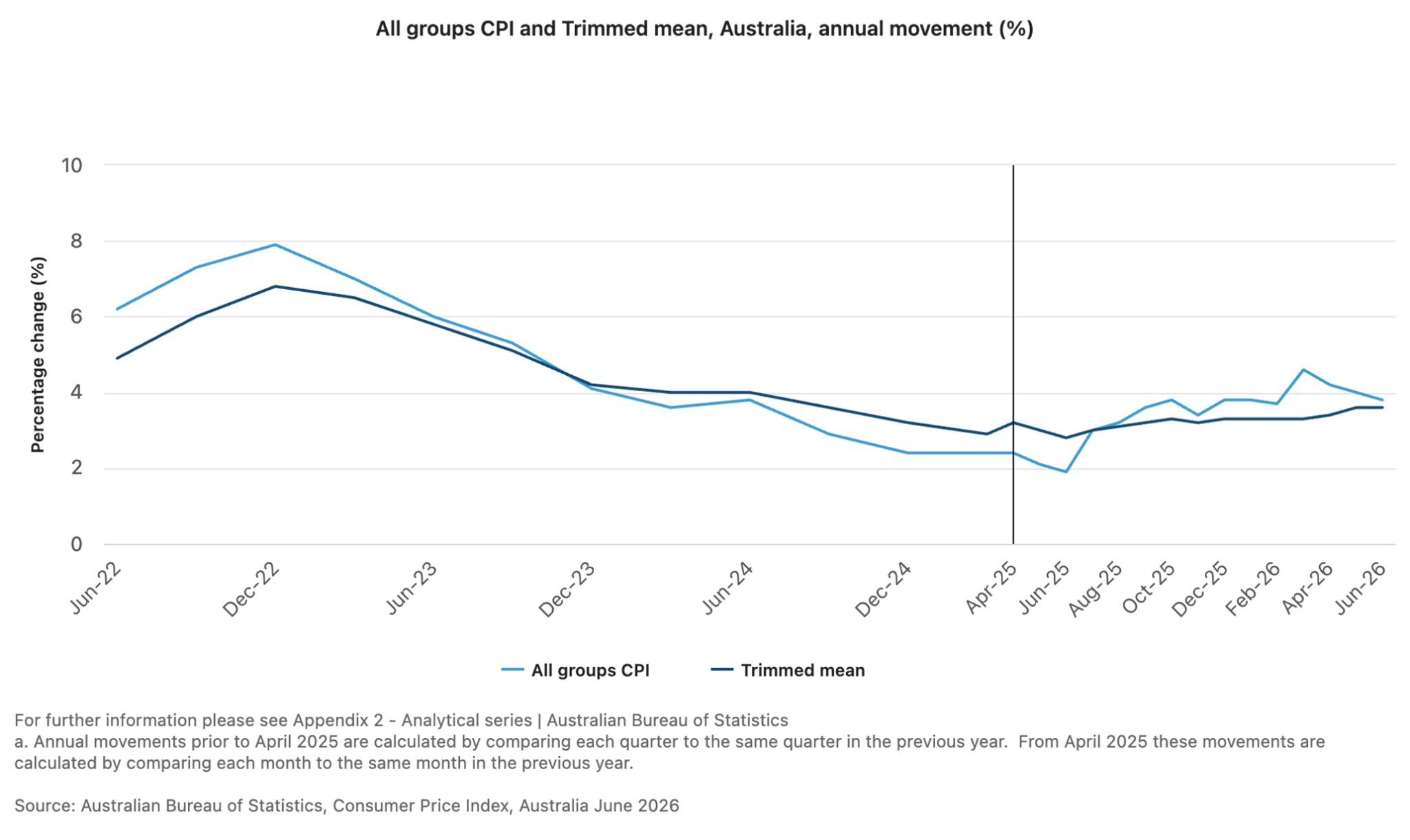
- Australian CPI slowed to 3.8% and August hike odds collapsed to 4%. What actually paid for that relief.
- The yen jumped 2.6% on a move the finance ministry didn’t confirm. Why we’re holding the Japan position.
- Report Spotlight: A local giant reported. The stock rallied amid headwinds. We outline why and our recommendation.
The fatLITE is the weekly read. Membership is the position.
The Verdict
For the US government, the cost of borrowing for thirty years reached a nineteen-year high this week. In the same four sessions, the equity market stopped rewarding companies for spending on artificial intelligence and started rewarding them for spending less.
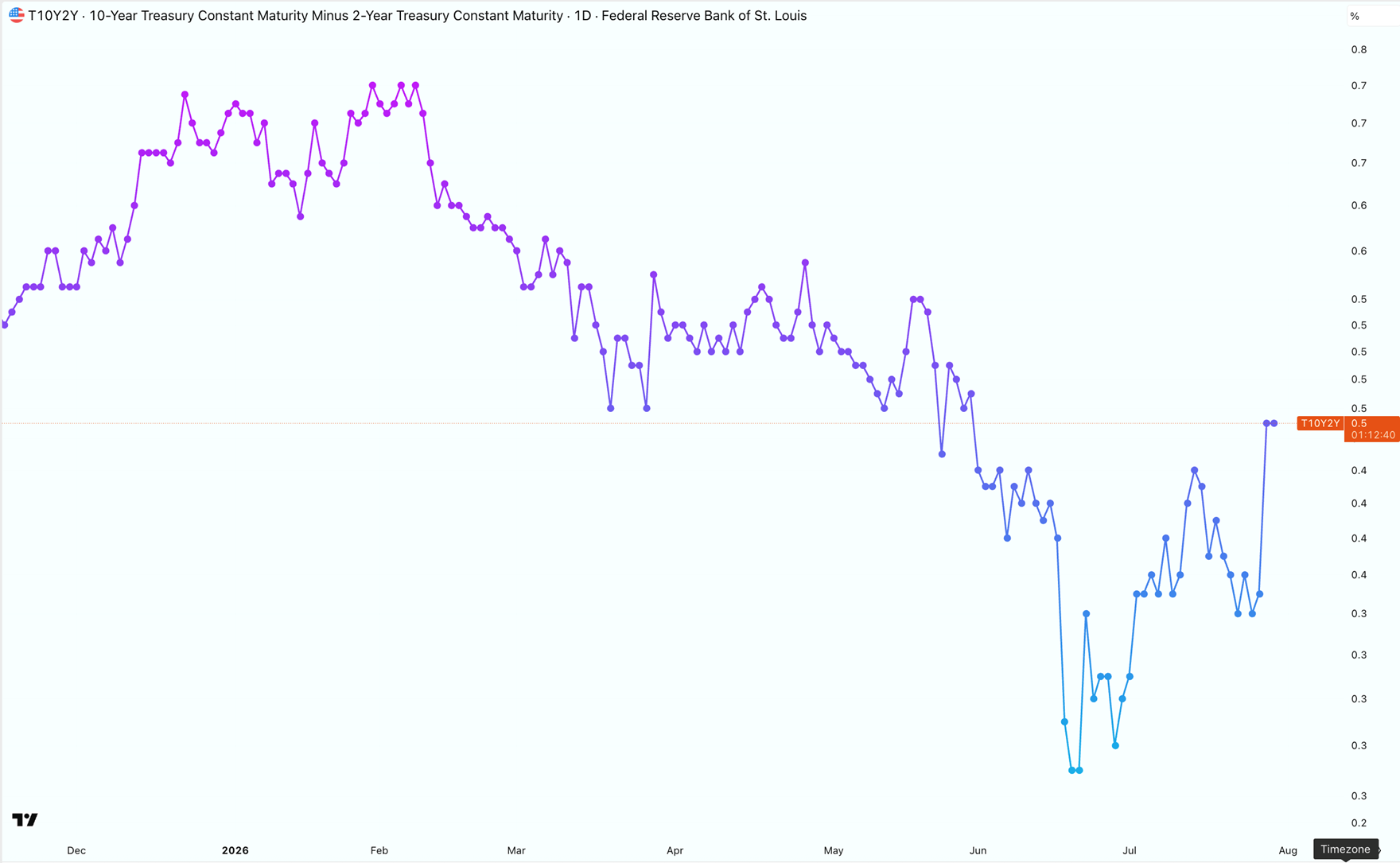
On Wednesday, the Federal Reserve held for a fifth consecutive meeting, three of its members dissented in favour of a hike, and Chair Kevin Warsh declined to say anything material about the September meeting. The 30-year Treasury yield rose 7.1bps to 5.17% that afternoon and kept going, touching 5.24% on Thursday, its highest since July 2007, a third consecutive session higher. A curve that steepens because the front end rallies is a market pricing cuts. A curve that steepens because the back end is being sold is a market demanding more compensation to lend for thirty years. The 2s10s spread finished near 46bps, having ground flatter all year to a mid-June low and surrendered the whole move in a handful of sessions.
The 10-year to 2-year spread has been on a roller coaster YTD.
Then on Thursday Microsoft added roughly $450bn in market value, up +15.5%, because it told the street its forward capital expenditure would come in lower than assumed. Meta, which had lifted the floor of its own capex range the night before, fell -8%. The week before, Alphabet also fell sharply when it lifted FY capex guidance.
These are two separate repricings that happened to land in the same week. The long end is not trading data centre capex. It is trading a Fed that has withdrawn forward guidance with core PCE still at 3.3% and the savings rate down to 2.7%, a four-year low. The equity leg had its own driver. Meta’s free cash flow fell to $784mn from $8.55bn a year earlier, while Microsoft paired its lower capex guidance with a commitment to keep generating cash through fiscal 2027. Last week, Alphabet reported its first quarter of negative free cash flow. The connection is long-duration cash flow funded increasingly with debt. One move raised the hurdle rate, and higher rates tighten the screws on builders relying on debt financing, and that is the same anxiety that showed up in the chip tape this past week.
We saw some harsh selling of chipmaker players midweek, before a rebound on Thursday – the moves were violent. Software inverted just as much, and the data centre construction names round-tripped with them. The equity market spent the week repricing the composition of the AI trade. Meanwhile, the Treasury market repriced the cost of money, with bond vigilantes sharpening their knives.
The Calls
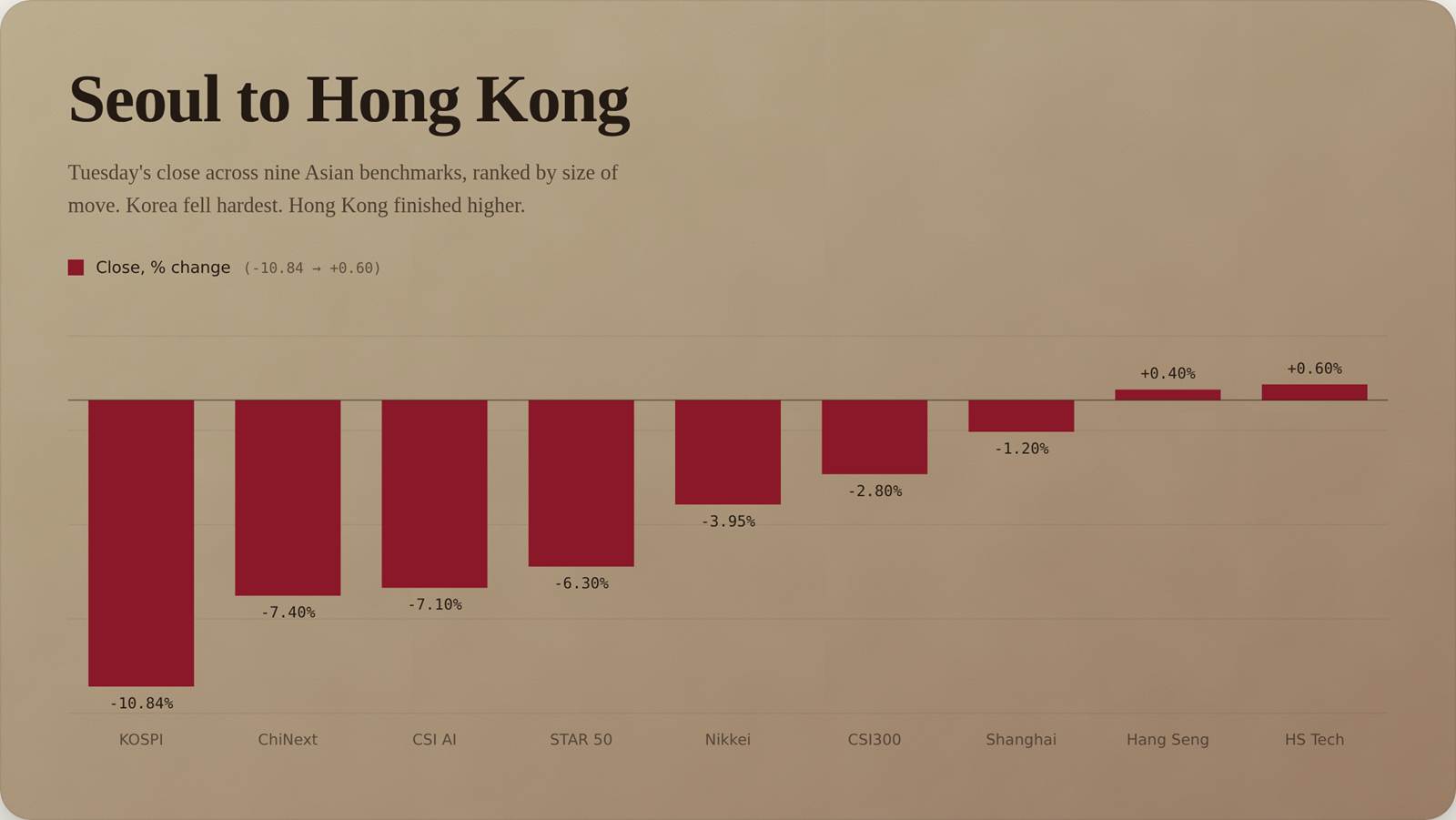
Copper was resilient amid the wild swings in the AI complex. On Tuesday, with the KOSPI down -10.8% in its eighth circuit breaker of the year, the Philadelphia semiconductor index off -4.5% and the ChiNext down -7.4%, copper fell -0.7% to $6.34 a pound. The metal with the most direct exposure to a genuine retreat in data centre construction declined less than 1% on the day the market was pricing exactly that. It then rose +0.8% on Wednesday and +2.8% on Thursday. It was interesting to see that copper shrugged off the bloodbath in tech that unfolded across Asia that day.
Our read is unchanged across the week: the market is repricing which companies capture the value of the buildout, not whether the buildout happens, and the physical demand schedule for the red metal is not what is being questioned. The structural deficit case sits underneath that. Rio Tinto’s first-half result gave the argument a number, with copper segment EBITDA up +84% to $5.7bn. The local expressions are BHP and RIO at the large end, and for pure plays, Sandfire Resources and Capstone Copper.
On oil, our base case is that the disruption resolves, and the forward curve is what makes that case rather than any view on the diplomacy. The forward strip runs from the front month down through the high $70s by mid-2027 and into the low $70s by 2028. The shape of the forward curve is pricing a supply interruption the market expects to clear – in line with our base case.
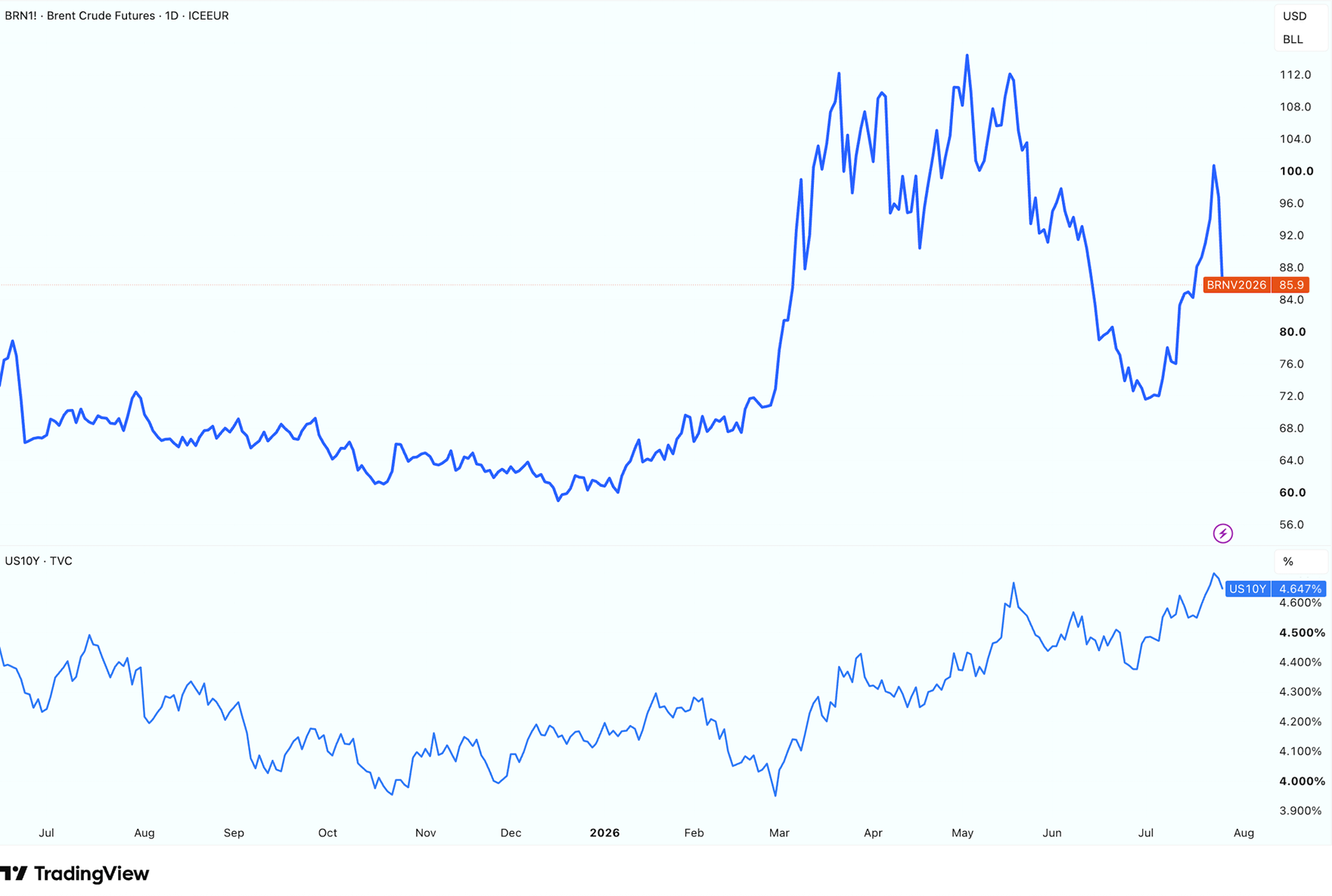
The chart below shows the war in two lines. Brent has round-tripped from $60 in November to above $110 in May and back to the mid-$80s now, while the US 10-year has travelled largely in one direction, from roughly 4% in December upwards to 4.65%. Crude has given back most of the conflict premium. Not so for the bond market.
We continue to expect further consolidation among gold producers. Evolution Mining agreed to acquire Carnaby Resources for $213m in scrip, adding the Greater Duchess copper-gold project in Queensland, and Carnaby closed up +57% on the day the news broke. That follows the larger Genesis Minerals and Vault Minerals merger. With gold holding above US$4,000/oz, the euphoria of late 2025 and early 2026 is long gone, but producers are still generating plenty of cash flow around these levels. Subdued equity sentiment (and the associated lower stock prices) against strong operating cash flow is the condition that produces deals.
The Local
The Australian market enjoyed a positive start to the week, reaching more than 5-month highs midweek, took a hit on Thursday, and was back on the front foot on Friday around midday. On Tuesday, Governor Bullock told a Sydney audience that housing and labour conditions were softer than the Reserve Bank had expected, and the money market repriced immediately. Market-implied odds of an August hike collapsed to around 4% from roughly 21% before the release, the three-year yield fell to 4.5%, and UBS pushed its next tightening call out to November while maintaining that the inflation outlook sits too high. For equity investors, the practical consequence was the removal of a macro overhang that had been suppressing rate-sensitive valuations for months, and the sector ranking reflected that – healthcare and consumer names led, banks lagged.
Rio Tinto was the week’s most important domestic result, and we dive into the details later – the immediate market reaction was a +3.7% pop on the day the results landed even as the broader materials sector was under pressure. The local technology sector produced the week’s clearest illustration of the global split occurring in tech. On Thursday, with the US technology complex having looked poor overnight, ASX tech rose +0.9% and was one of only two sectors to gain. The overnight damage had been in chips while software rose, and the local sector is weighted to the latter. WiseTech gained +6.7% on the day and ran through most of the week. Even after the stock was headed lower on Friday, it was up a strong double-digit percentage over the past week. Meanwhile, data centre plays NextDC and Megaport were the opposite, largely bleeding red ink.
Report Spotlight
Rio Tinto (ASX, UK, US: RIO) – Buy
Rio Tinto’s June half was its best in four years, and the earnings mix shift is the real story. Underlying earnings jumped 43% to US$6.85 billion, EBITDA rose 28% to US$14.8 billion, and free cash flow surged 75% to US$3.83 billion, comfortably beating broker forecasts. Copper is now a genuine second pillar. Copper EBITDA of US$5.7 billion beat expectations by ~9% and now contributed roughly 36% of group EBITDA, narrowing the gap with iron ore’s 43% and confirming structurally growing leverage to electrification, AI-driven data centre demand and grid investment, alongside strong output from Oyu Tolgoi and Kennecott.
Iron ore remains the largest single earnings contributor and a genuine cash machine, with volumes and unit costs tracking in line with guidance. Aluminium is quietly adding further diversification, cushioning the portfolio against any single commodity’s downside. Net debt has fallen to ~US$14 billion, supporting a record, above-consensus interim dividend of US$2.11 per share. FY26 production guidance remains unchanged across all major assets.
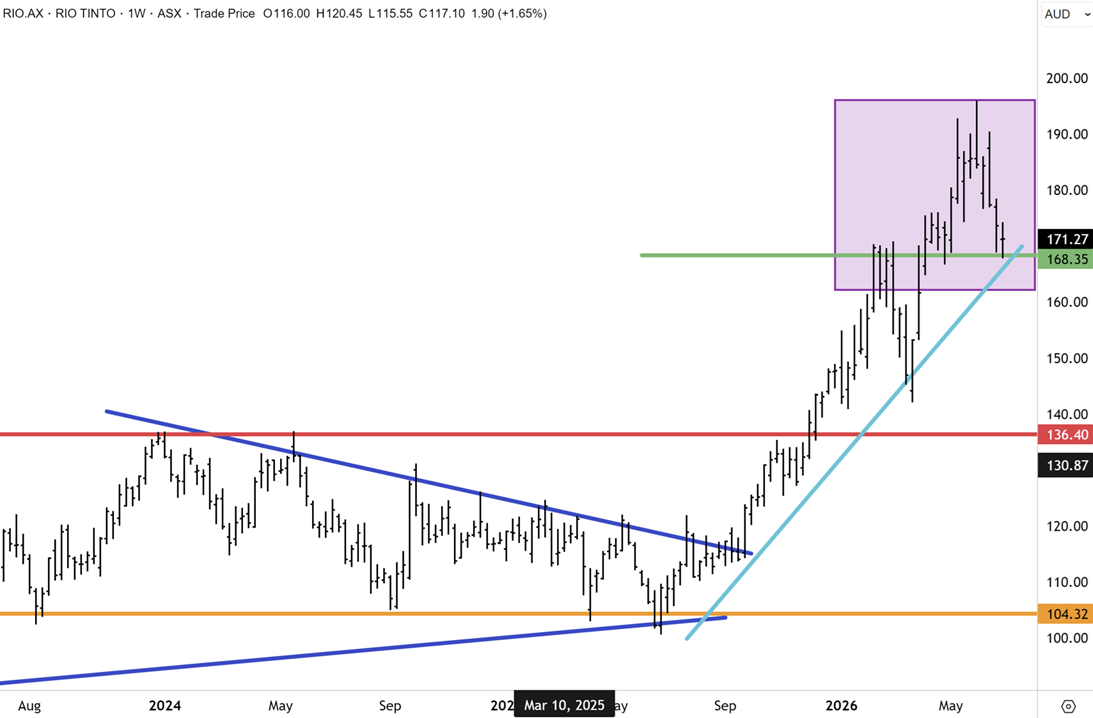
Rio Tinto made a new record high above $200 and has since corrected sharply back to key support at $168, which intersects with the uptrend in place since September last year. The recent fresh record high in Rio coincided with copper making a new record high above $6.60/pound and iron ore touching $111. Near term, both commodities have come under pressure from modest headwinds in the US dollar.
Rio could undergo some consolidation before upward momentum resumes, but the pullback opens a potential opportunity from a technical perspective. Upward momentum could soon resume if the dollar weakens and the bull market in commodities resumes, which is out base case. Rio is well supported at $170 and below in our view. We continue to have conviction that Rio will retest the record highs later this year given our bullish outlook for commodities, copper, and iron ore.

Everything in this fatLITE is the surface. The full reports, macro commentary, model portfolio, and buy recommendations are members-only. Try it with our 30-day money-back guarantee.
Have a great weekend.
Carpe Diem
The Fat Prophets desk

