

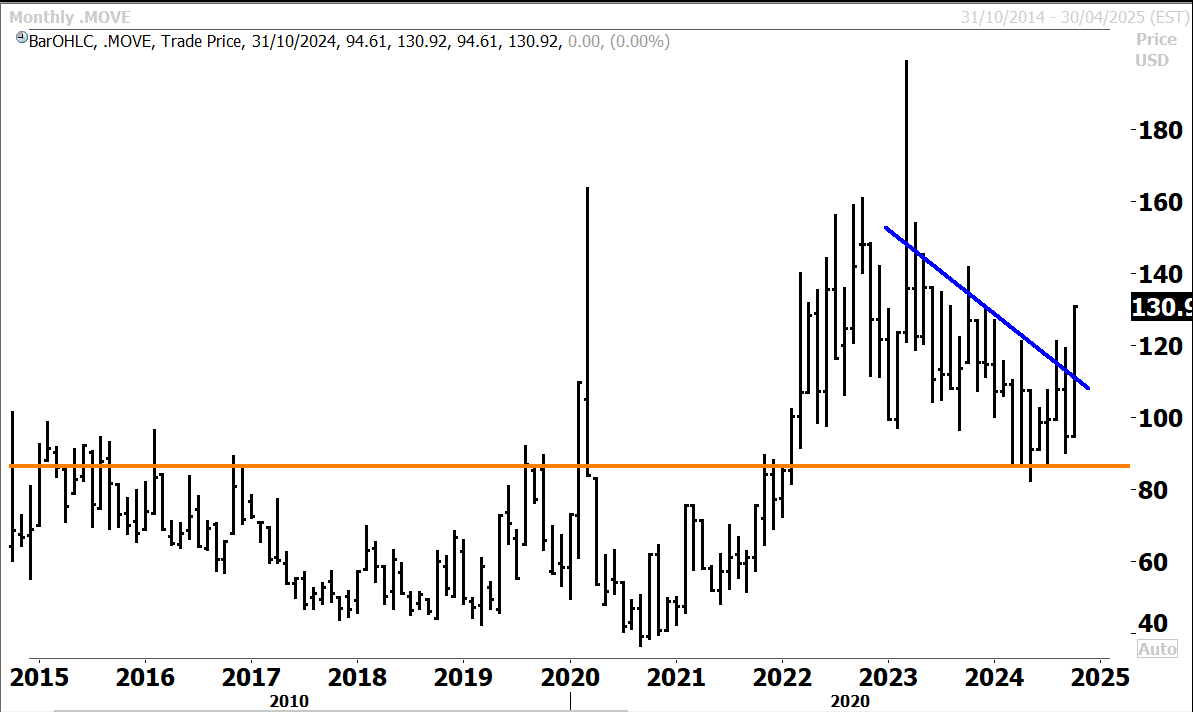
US interest rate options are pricing in a Republican sweep. Option markets are braced for biggest post-election swings in 30 years with risks around a Republican sweep potentially elevating inflation with higher tariffs. Bond yields are one risk and yesterday I mentioned that the 4.3%/4.4% level was key on the US10yr. An advance above that level could raise scope for a retest of the decade highs above 5.1%. Conversely, a Democratic win could result in [stu alias=”daily_3010″]
The MOVE index, which measures volatility in the bond market (as opposed to the VIX in the stock market), has broken out and is moving higher. We are likely in for some extreme volatility in the bond market over the coming week with the labour market data out (that will underpin or push back on the rate cut narrative) and of course the US election.
If Republicans have a sweep and take both houses of Congress and the US presidency, it likely would bring higher tariffs and higher bond yields – especially at the long end of the yield curve, due to inflationary risks. Additionally, increased US Treasury debt supply to finance a huge fiscal deficit would not only pressure the long end of the yield curve – but also undermine the US dollar (a high conviction Call of mine). Whilst some investors are hedging through short positions in long-dated bonds, we have opted for precious metals including gold, silver, platinum and palladium.
While the interest rate options market is behaving as if it’s expecting a higher probability of a Republican sweep, in terms of next week’s outcome is anybody’s guess. The US political spectrum is highly polarised, and polling points to a neck-and-neck result. A gridlock outcome where a Republican or Democrat win is constrained by the opposite party seizing control of the upper or lower houses, could also have very different implications for financial markets. A lot is going on.
While volatility is heightened in the bond market, the VIX has notably eased in the stock market. I have said the vol spike highs seen during August in the VIX during the big short yen carry trade, will not occur again this year. One rationale for the lower VIX (as opposed the higher MOVE index) is that equity markets do not really care who gets elected. Both Trump and Harris have suggested significant increases in the budget deficit through increased fiscal spending. This underpins our view that ultimately the US dollar is going to be headed lower. A lower greenback will provide a positive backdrop for not just precious metals and commodities, but also emerging markets – and here we are positioned in China/Hong Kong equities.
Moving on, a report surfaced on Reuters overnight that China is weighing the approval of a 10 trillion yuan (US$1.4 trillion) fiscal stimulus package and support for additional borrowing to shore up the economy and address local governments’ debt risks. Reuters did not reveal the source of the fiscal stimulus package, but said that timing would be next week. The fiscal stimulus might be approved at a meeting by China’s top legislative body, which is held next week between November 4th and 8th. The package was said to have included 6 trillion yuan in debt to be raised over three years (including the rest of this year) to help local authorities resolve off-balance sheet debt, as well as 4 trillion worth of debt funding for regional governments to buy idle land and vacant properties over the next five years. This would go along way in shoring up the ailing property market and boosting consumer confidence. China has the highest savings rate in the world as consumers hoard cash given the economic uncertainty.
According to the report out on Reuters, the stimulus package might be even bigger if Donald Trump wins the White House next week because of policies that will target China with higher tariffs. This would be the biggest (and most influential) stimulus package since the pandemic and 2008.
China has fired the fiscal bazooka on two other occasions. Between 2008-2009 during the Global Financial Crisis, China launched a major ¥4 trillion (about $586 billion) stimulus package, mainly focused on infrastructure, social welfare, and housing. This was one of the largest stimulus packages globally during that period and played a significant role in stabilizing China’s economy.
Between 2015-2016 when China was facing an economic slowdown and declining stock markets, China initiated a series of stimulus measures, including infrastructure investments, tax cuts, and targeted monetary policy easing, to support growth and prevent a “hard landing.” This was the catalyst also defined the bear market lows in commodities and the resources sector. At the BHP and Rio, along with a host of other commodities declined to bear market lows. If Beijing comes out with a big fiscal stimulus package next week, this will have very bullish ramifications for the resources sector and commodities generally.
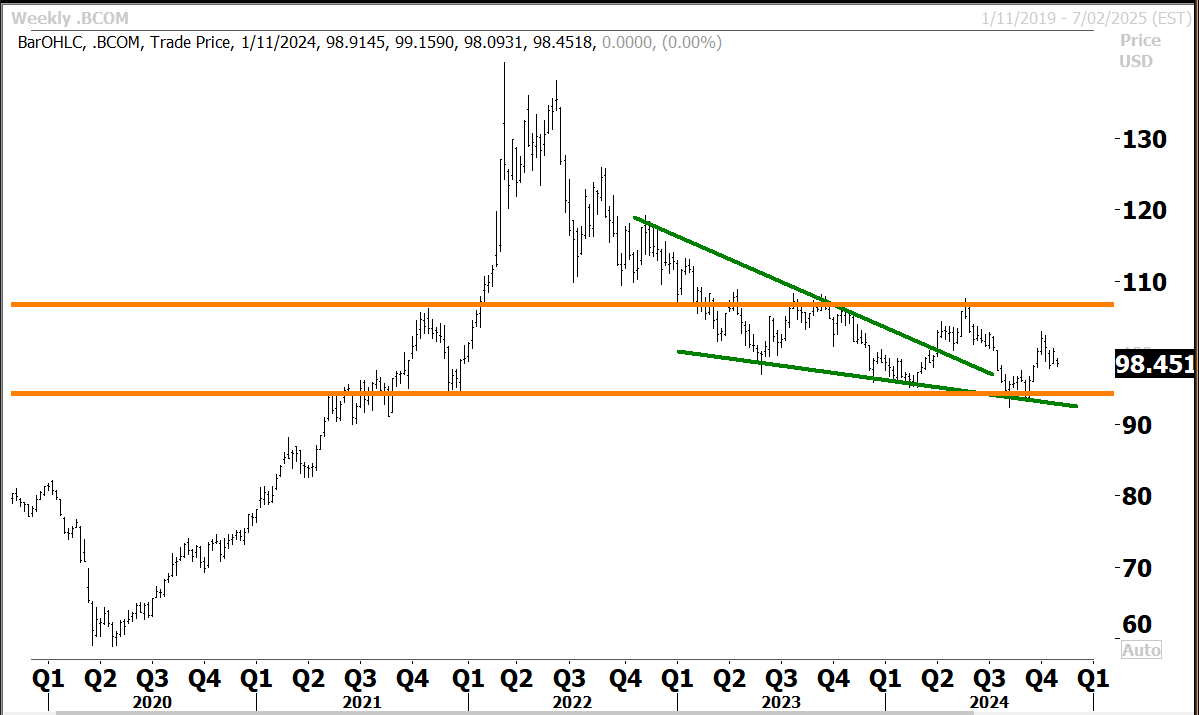
The Bloomberg Commodity index has traced out an important bottom with upward momentum looking to reassert in coming months. A fiscal bazooka from China would be one potential catalyst for a big rebound. Another catalyst (and one that I believe will occur next year) is the onset of a secular bear market in commodities.
Carpe Diem!
Angus
Disclosure: Fat Prophets and its affiliates, officers, directors, and employees may hold an interest in the securities or other financial products relating to any company or issuer discussed in this report. Fat Prophet’s disclosure of interest related to Investment Recommendations can be provided upon request to members@fatprophets.com.au.
Chart Source: Thomson Reuters

