

Key Market Insights and Stocks Covered This Week
- The S&P 500 hit a record on Tuesday. Two of our three calls for the week played out, and one didn’t.
- On Thursday, bonds rallied while oil rose, breaking the typical pattern in recent months.
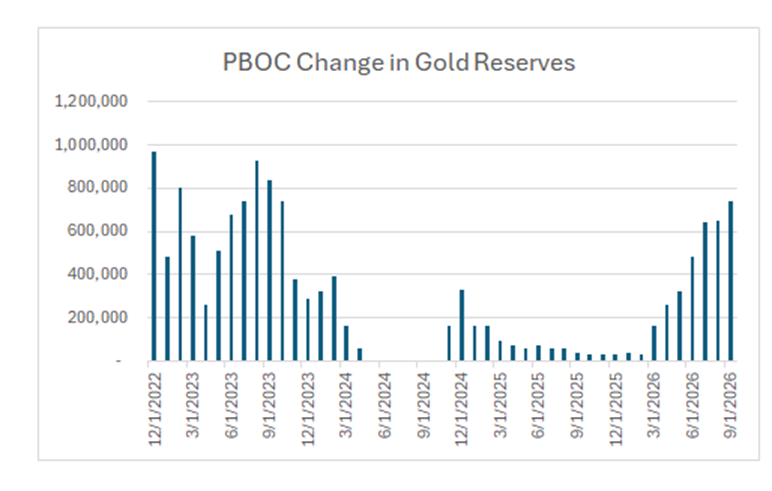
- China has bought gold for 23 straight months, and it stepped up buying as prices fell.
- US earnings season starts next week with strong earnings growth expected, and investors seem to have lost sight of it.
- Ray Dalio is warning of a US debt crisis within three years. We think he makes some good points, and we still expect bonds to rally in the short term, though the long-term is a very different story.
- The RBA’s pain threshold is 5% unemployment. The last reading was 4.6%.
Report Spotlight: CSL
The fatLITE is the weekly read. Membership is the position.
As a fatLITE reader, you can join Platinum, our full service, at the discounted price of $695 a year. Join Platinum at $695
The Verdict
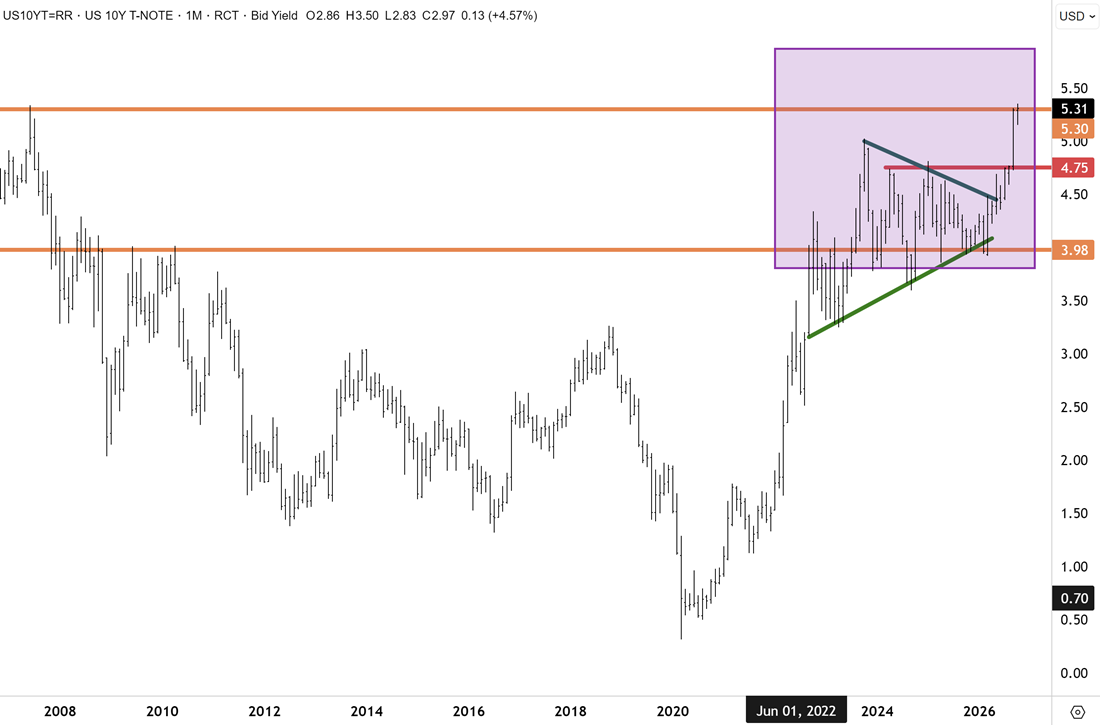
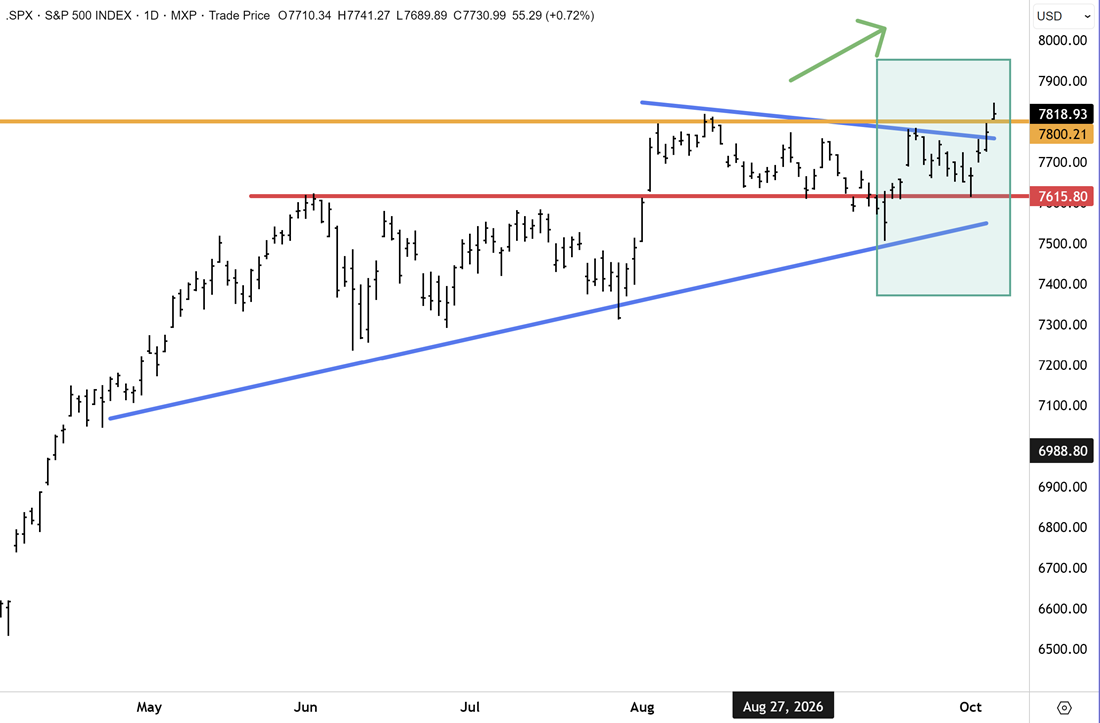
We have been positioned for calls that US bond yields are close to peaking, that equities look strong into year-end, and that oil would move lower. Two of the three played out during the week. The S&P 500 hit a record on Tuesday, then eased slightly to 7,765 by Thursday’s close. The 10-year Treasury yield closed at 5.32% on Monday, near the 2007 highs we expected to cap it, then fell to 5.22% by Thursday. Our near-term miss was oil. WTI held support and rebounded on Thursday instead of breaking lower.
On Thursday, bonds rallied even though oil rose. The two have largely moved together in recent months. Bond market volatility has also eased. We think the peak in yields is now largely priced in for this phase, and bonds are stabilising. Longer term, our base case is still a multi-year bear market in bonds, with gold, commodities and real assets as the hedge.
We have maintained the view that the bull market is intact and that weakness in most international markets is a short correction. Historically, September is the weakest month of the year, and corrections more often than not end in October. We see more upside than downside into year-end. Oil remains the swing factor. Most investors are excessively pessimistic about a de-escalation. While that is understandable after earlier progress failed to hold, this pessimism is now priced in, and the setup doesn’t need to improve much to be a positive for markets. On rates, we do not expect the Fed to hike in October. Markets are pricing three hikes between December and March. If oil falls, we don’t see this happening. Meanwhile, at home in Australia, our view is that job and housing market fragility mean the RBA’s last hike is likely the peak in this cycle.
The Calls
Bonds
The 30-year Treasury yield touched a 24-year high of 5.73% on Wednesday before easing, and by Thursday the 10-year was at 5.22% and the 30-year at 5.6%, after well-received Treasury auctions and comments from Fed Governor Chris Waller pushing back on the timing of the next hike.
Bond yields don’t need to fall back to levels seen earlier this year for the stock market to rally. We just need bond volatility to subside, and the 10yr to ease towards what is likely a new floor near 5%.

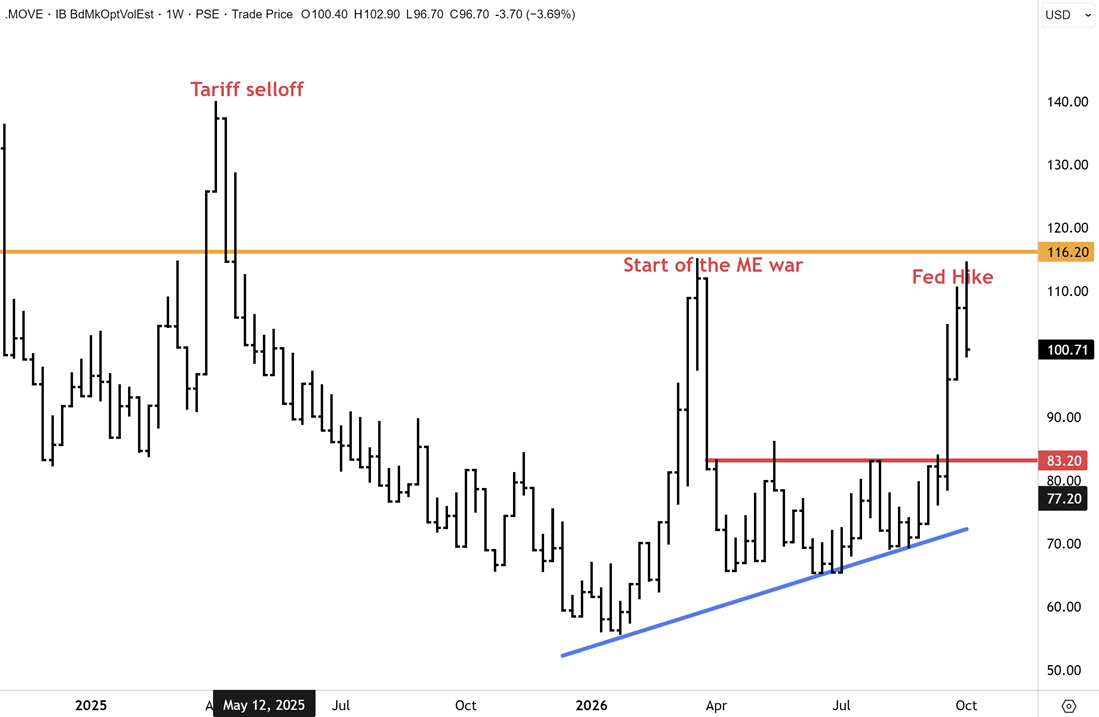
Bond volatility is already falling. The MOVE index fell to 105 on Tuesday and 100 on Thursday, well down from its recent peak. A further retracement lower in oil prices could push the MOVE index back down towards 85 in the coming weeks. This would remove a significant pressure point on financial markets.
In an interview, Ray Dalio warned again that US Treasuries are vulnerable to a pullback in demand from Japan and China, the two largest foreign creditors. I have been of the same view for some time, especially with the sharp pivot in US foreign policy that has played out in recent years. Global appetite for US bonds is likely to wane, especially in Japan, where domestic investors are now finally getting a return on JGB’s for the first time in decades.
Mr Dalio emphasised in the Bloomberg interview that “A lot of that is coming from Japan and China. The Chinese don’t want to continue to accumulate — there are geopolitical issues as well as economic issues. When you have a debtor-creditor relationship, and you have an adversary relationship, that’s a very difficult dynamic.” That’s a fair point, and on that front, I would add that China has been steadily running down US Treasury holdings and diversifying financial reserves through buying a lot of physical gold (Ray is also a gold bull).
Ray Dalio is warning of a US debt crisis within three years. He will likely be right, in our view, which is why we hold a lot of gold. However, the big selloff in US Treasuries now looks overdone. Bonds are primed for a rally over the coming months in my view.
Oil and the Strait
Middle East crude exports are back near pre-war levels, and WTI spent Monday and Tuesday testing support near $89, where its uptrend line meets the 50-day moving average. Support held. On Thursday, WTI rose to $91.36 and Brent to $104.14 after attacks on shipping and on two Saudi airports. A breakout above the one-month range at $95/$96 could take WTI higher, though Thursday’s move was helped by a hurricane that has temporarily shut some US production in the Gulf of Mexico. Our base case remains for supply to normalise from the ME and sooner or later, key support will be tested and possibly broken on the downside.
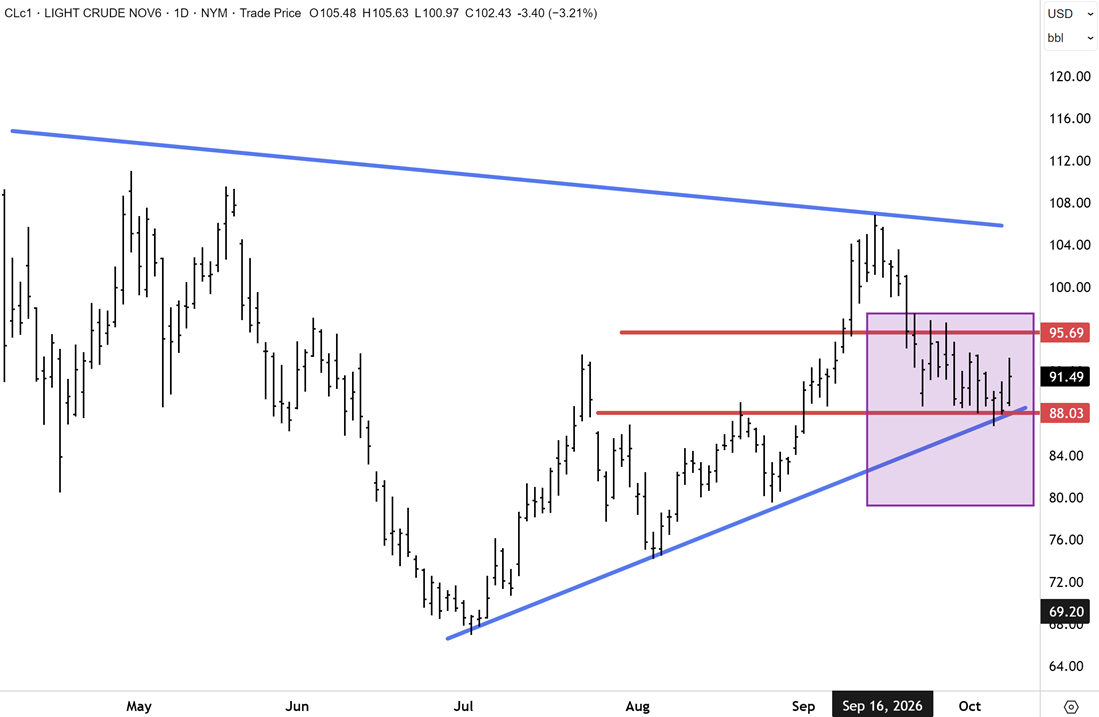
Talks between the two sides continue. Iran is reviewing a US response to its proposal under which the Strait could reopen within seven days, and President Trump said the US would not attack Iran before the November 3 midterms. Hawkish rhetoric at the Fed and other central banks is likely to quickly dissipate if oil prices come back down towards $70/$80 a barrel.
Equities
The S&P 500 broke out to a new record earlier in the week, and we see more room on the upside than the downside. Our next price target is 8,000 by December. The index could overshoot that level by several hundred points if three things happen: earnings beat consensus, oil prices fall, and the Fed holds off on another rate hike this year. Markets currently price in 75 basis points of hikes between now and March 2027.
Earnings season starts next week with the banks. Consensus expects S&P 500 earnings growth of 30.6% for the September quarter. JP Morgan’s trading desk noted that tech, industrials and healthcare lead the record number of positive pre-announcements, and that all 11 sectors are expected to grow revenue. This is one of the strongest earnings setups in a decade, and investors seem to have lost sight of it during the correction since August.
Strategists at JP Morgan, Morgan Stanley and UBS have turned more bullish. JP Morgan’s Mislav Matejka said “investors have gotten too bearish on stocks, with earnings expected to remain robust and the surge in bond yields looking increasingly stretched.” Morgan Stanley’s Mike Wilson said the pullback has created a “better setup” for sectors linked to the economic cycle. UBS sees room for shares to rise over the next six to 12 months. JP Morgan expects cyclicals (financials, industrials and commodities) and a rebound in tech to lead the recovery. That is the playbook we have been running for several months.
Gold
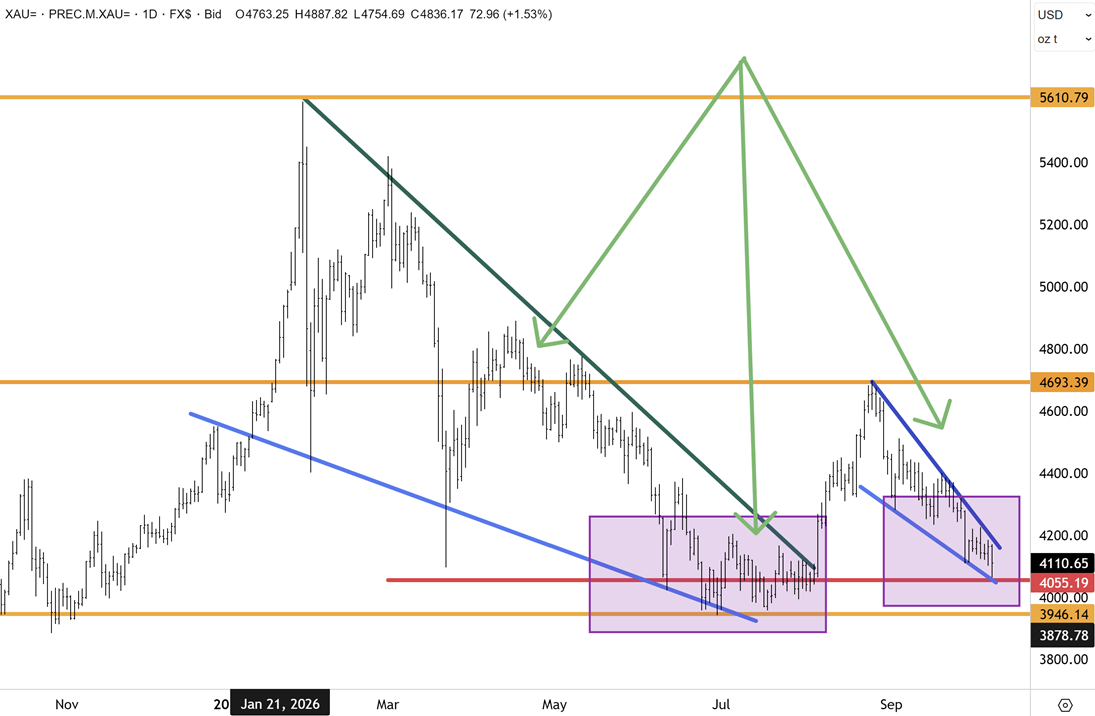
Gold has corrected from August levels, but held up pretty well this week and firmed 0.5% during Thursday’s US session to $4,158, rebounding further after the move lower earlier this week. Someone is buying in size and accumulating similar to what played out back in June/July.
Figures out this week showed China’s central bank added 740,000 ounces to its reserves in September, its 23rd consecutive month of purchases, and Morgan Stanley noted that its buying has stepped up since prices fell. The pattern is similar to four months ago. China is almost certainly the main buyer, but it wouldn’t surprise us in the least for other central banks and sovereign wealth funds to also be on the bid.
JP Morgan’s strategists see the pullback as a chance to add to positions on renewed concerns about currency debasement. Its trading desk now sees Chinese buying as a floor under gold at $4,000, with a path back towards $5,000 whether real yields fall or debasement fears take hold. We agree.
The Chinese Government has designated gold a “strategic mineral” and has promoted physical bullion as a store of value for households. Whichever way inflation and bond yields go, we expect gold to be a lot higher in six months. Russian selling into Hong Kong has weighed on prices this year, and an end to the Ukraine war could stop that selling and tighten the market.
Under our base scenario, gold could quickly advance back towards the August highs near $4,700, the “neckline”, which potentially sets the market up for a bullish technical inverse head & shoulders pattern. With potentially the “left shoulder” and “head” patterns now in place on the chart below, the final stage of the corrective move could be playing out with the formation of the “right shoulder”.
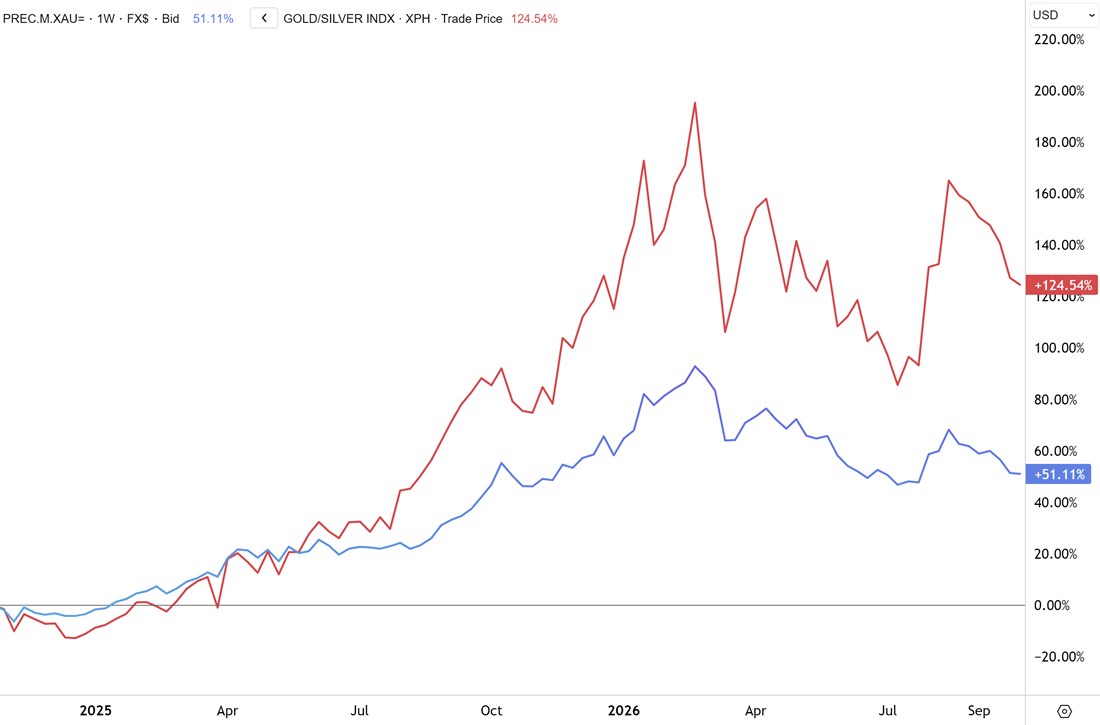
Gold and silver miners have held up better than bullion since August, supported by earnings growth, free cash flow and rising dividends.
Uranium
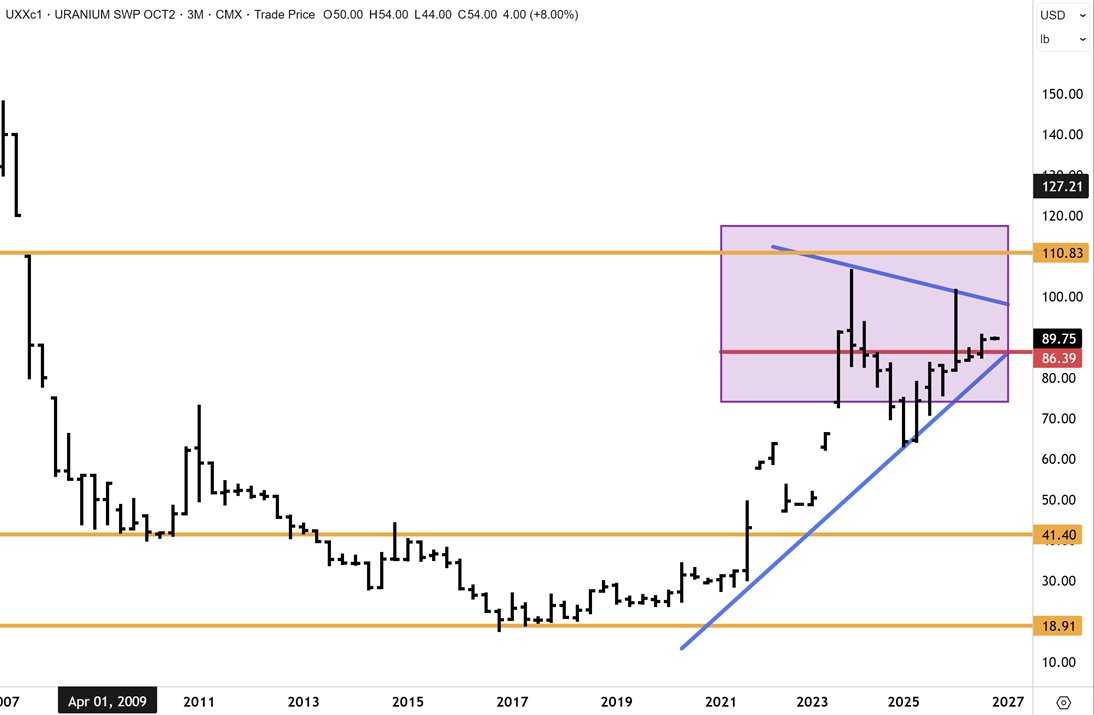
We have been long-time bulls on uranium. Google agreed this week to a 20-year deal to buy power from a new Constellation Energy reactor, and uranium prices have turned higher on supply concerns around Russia. The investment case rests on a mismatch between demand and supply that is favourable for investors. In our view, higher uranium prices will be needed to fund new mines.
Uranium prices have in recent months reasserted themselves above the primary uptrend line in place since 2021. Uranium surged to $110 a pound following a breakout and exit from a decade-long range. For much of the past eighteen months, uranium has consolidated within a large range, establishing a series of higher reaction lows. The technical setup skews bullish, and we anticipate a retest of the highs above $110 over the coming year, which is consistent with our commodity super cycle thesis.
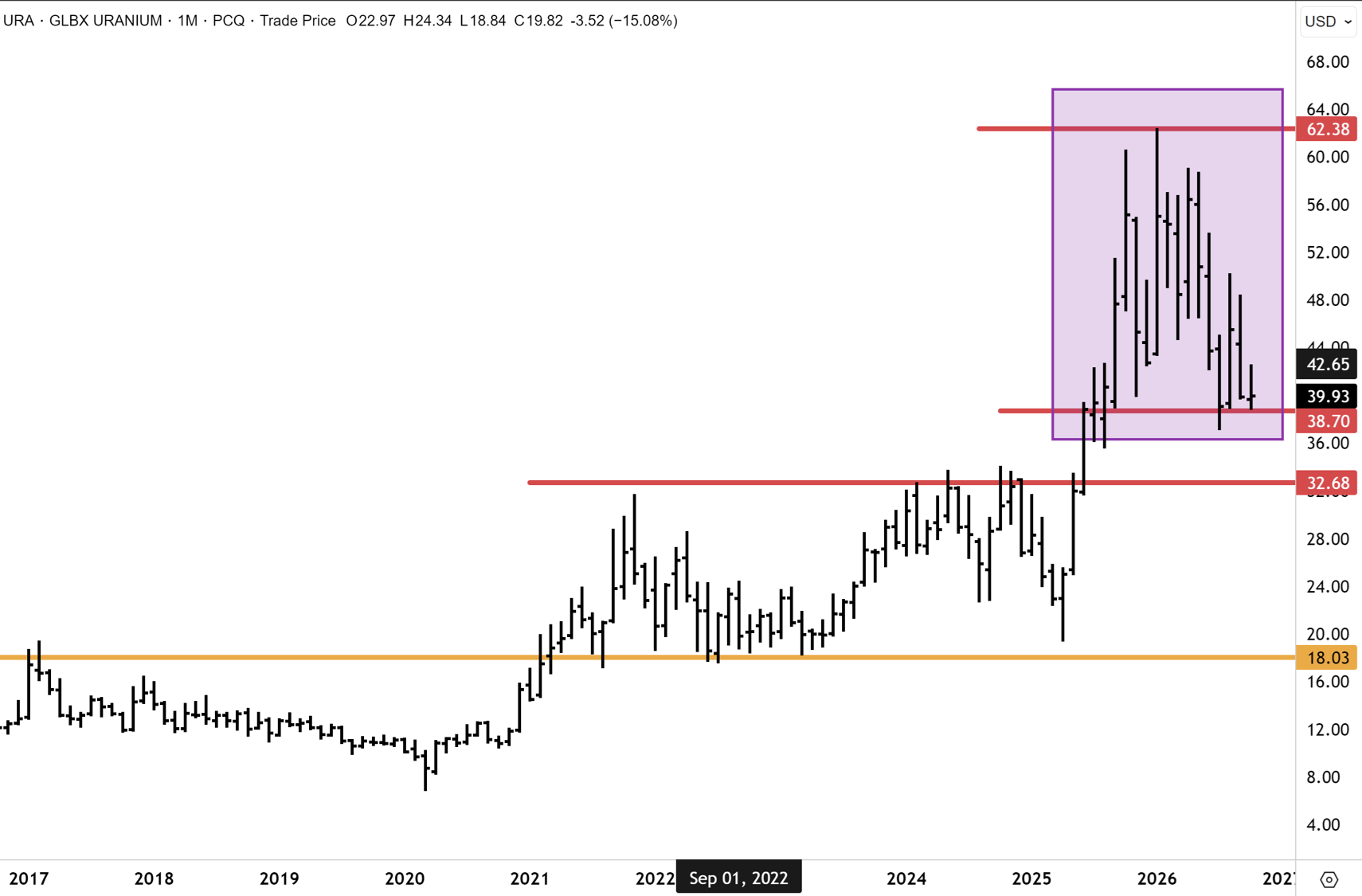
For the Global X Uranium Miners ETF (US: URA, ASX: ATOM), the correction to support around $39 looks close to completion. We anticipate a coming inflection and for URA to also resume upward momentum over the coming year, and our base case is for an initial retest of the 2025 $62 high.
The Local
The ASX 200 rose on Monday and Tuesday, closing at 8,735 for its third straight gain, before finishing nearly flat on Wednesday and falling 0.8% to 8,660 on Thursday as local bond yields and oil rose. The index recovered on Friday, up 0.6% at 8,716, with 9 of 11 sectors higher. Technology and discretionary led on Friday, up 2.2%, ahead of real estate, up 1.8%. Telecommunications was the only sector that fell much, down 0.6%, while materials were flat, even as the gold miners sub-index rose 1.9%. The Westpac–Melbourne Institute consumer sentiment index fell 4.7% to 80.4 in October on worries about interest rates and living costs.
Markets are pricing in a ~75% chance the RBA holds in November. I think the RBA could be done hiking given the pressure now coming through from the housing market, consumer sentiment rolling over, and unemployment increases. Unemployment last printed at 4.6%, close to the 5% the RBA has defined as its pain threshold. There is risk around the economy falling into recession, but I don’t think the RBA will push it that far.
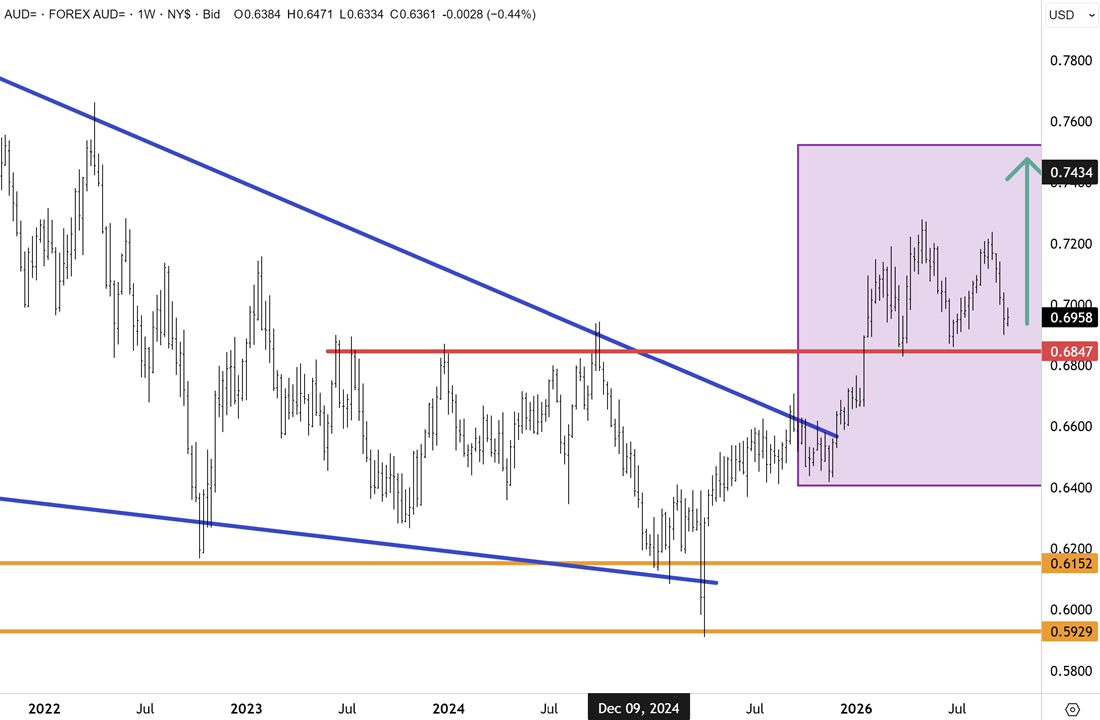
There are some prominent bears on the A$ at current levels. We are not among them. Commodities, including gold and copper, are in a bull market, and the three Fed hikes priced in are at risk if oil falls. Similar to the euro, the A$ has exited a primary downtrend and extended higher throughout much of 2025. The A$ has corrected lower, but support remains quite formidable at 68c and below. I don’t expect the Fed to put through three more rate hikes, while the A$ typically benefits from rising commodity prices.
Report Spotlight
CSL (ASX: CSL) – Buy
CSL is paying US$355 million upfront to partner with Alentis on lixudebart, a kidney and liver drug that targets inflammation and organ scarring. Alentis can earn up to US$1.2 billion in commercial milestones. CSL will also fund the remaining kidney trial, a larger follow-on trial and studies in two further diseases, and those costs have not been quantified. CSL takes 55% of profits after commercialisation. The early data are encouraging but come from small studies: 26 kidney patients at 24 weeks and 41 liver-fibrosis patients at six weeks. There is no launch date or revenue forecast, so this adds to the longer-term pipeline rather than upgrading earnings in the near-term. Still, CSL has staged a strong rebound after being excessively sold, and this development adds support.
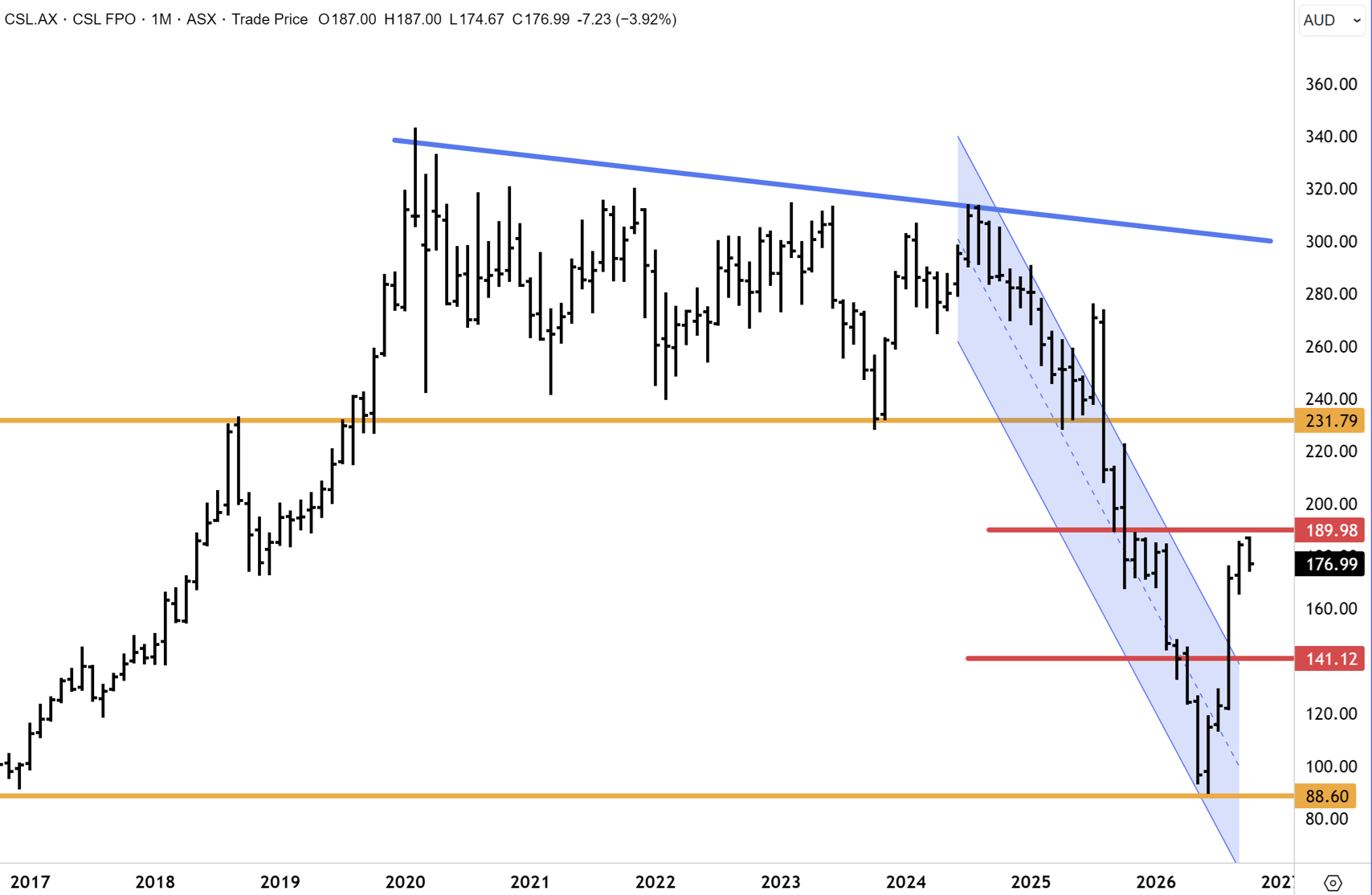
CSL has constructively consolidated just below overhead resistance near the $180 to $190 zone, which is highly encouraging. We remain of the view that CSL has passed through and completed a bearish extreme, given pervasive market pessimism, widespread investor capitulation, and numerous fund managers exiting the share register. We believe the path of least resistance now lies to the topside and hold conviction that a major chart inflection has been confirmed. Moving forward, we expect CSL to consolidate further over the coming months beneath immediate overhead resistance around $185 before confirming a topside breakout to continue its broader advance. Once this overhead barrier is cleared, we anticipate a further recovery targeting $230.
This fatLITE is a short version of what our members read. Platinum members get:
- fatCHAT, our market note, four mornings a week, Tuesday to Friday
- the full fatWRAP every Friday
- every stock report across Australasian Equities, Global Equities and Global Mining, each with a clear buy, hold or sell call
- other member content, including webinars
As a fatLITE reader, you can join Platinum at the discounted price of $695 a year, and it stays at $695 when you renew. Join Platinum at $695
Have a great weekend.
Carpe Diem!
Angus

