

Chequered flag
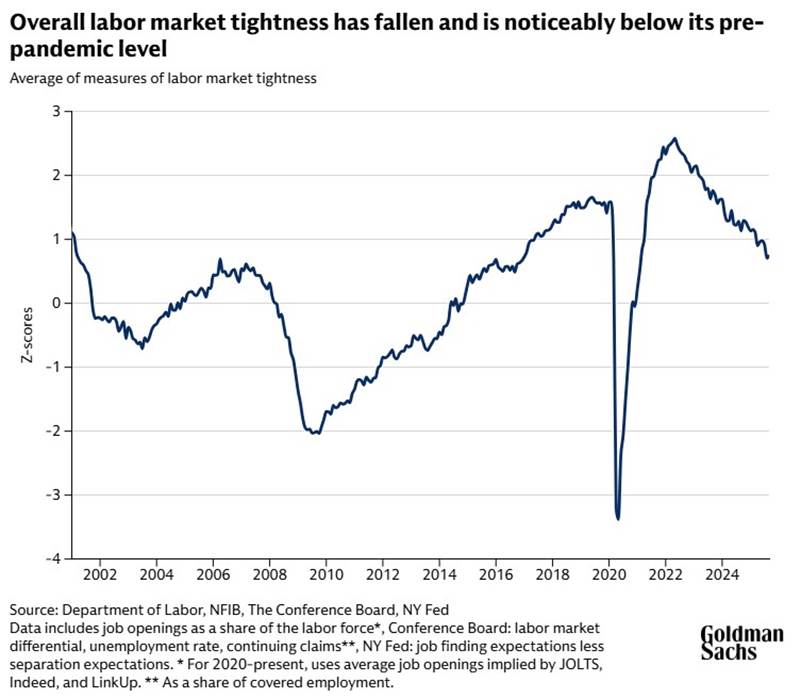
According to Goldman Sachs, Fed Chair Jerome Powell was more hawkish than many expected during the central bank’s press conference last week. However, Goldman’s Chief US Economist David Mericle still expects the Fed to cut rates next month.
Last month, Jerome Powell said a rate cut in December was “not a foregone conclusion”, acknowledging “strongly different views” on the FOMC, which sets the fed funds rate. The policy committee cut its target rate in October for the second time this year, lowering the fed funds rate by 25 bps to 3.75-4%. However, Goldman sees signs that the weakness in the US job market “is genuine” and a rate cut as being likely because, on balance, the FOMC will not want a further slowdown.
Source: Goldman Sachs
I agree with this outlook, and all that is likely needed now is for the September/October labour market reports to confirm further job losses, and the stage will be set for a rate cut in December. With the upward inflection in the stock market on Monday, accompanied by signs the Fed is leaning towards another rate cut, our base case for a “risk on” rally into the year-end remains intact. Additionally, the improvement in commodity markets across the full spectrum is also encouraging and points to a strong US and global economy next year.
Goldman is also bullish on the outlook for China. The investment bank noted on the weekend that “one of the biggest concerns for investors around the world has been trade tensions between the US and China. But despite the tariffs, China’s exports have been resilient. “Between the structural trends in Chinese manufacturing, competitiveness in these high-tech sectors, and rerouting and supply chain responses, we’re seeing a super resilient Chinese export picture this year”.
Goldman noted that “at last month’s Fourth Plenum, Chinese policymakers laid out a five-year growth plan that commits to building a modern industrial system and further advancing manufacturing competitiveness. And last week’s Trump-Xi meeting may further support China’s export growth, as both countries agreed to pause certain tariffs and export controls.” The deal on tariffs was a circuit breaker for China’s economy in my view, and buys a lot more time for the government to shore up alternative export channels with other countries.
Consequently, Goldman Sachs raised their China GDP growth forecasts to 4.8% for 2026 and 4.7% for 2027 (up from 4.3% and 4%, respectively). These forecasts are significantly above market consensus. I am not surprised that China’s CSI300, Shanghai Composite and Hang Seng Indexes have reasserted upward momentum in the past week. The bull market, which has seen all benchmarks outperform global equities this year, could well continue into next year. The strong growth outlook held by Goldman (an outlier) is likely being priced into Chinese equities ahead of what could be a resurgence in the economy and consumer spending next year.
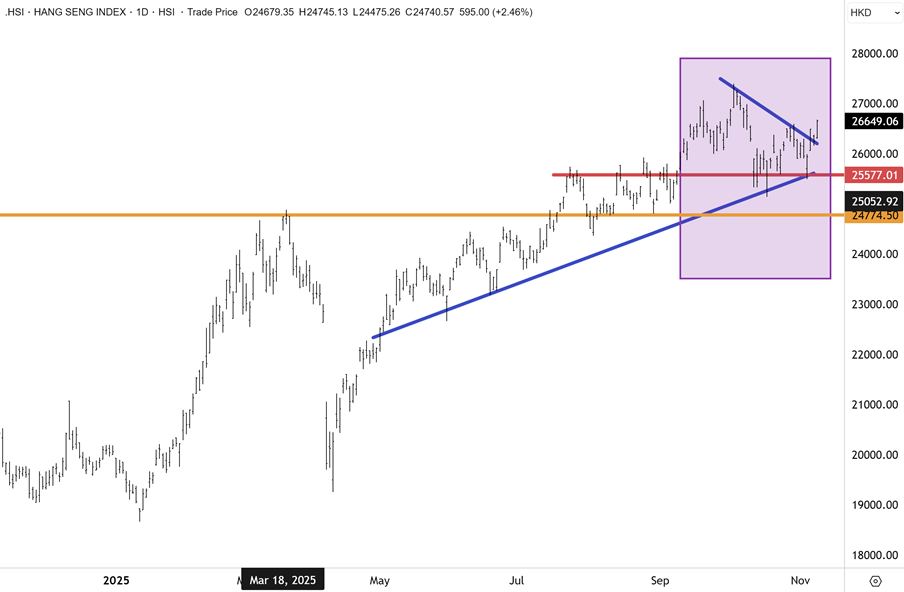
The +6% correction in the Hang Seng index, which has undergone a six-week consolidation since early October, now appears to be over. The breakout above the near-term downtrend around 26,000 likely concludes the technical correction and marks the resumption of upward momentum. I am anticipating a retest of the record highs by year-end.
The correction in gold and other PGMs that has been playing out since October, when conditions became quite overbought and frothy, might have also concluded. The “chequered flag” on the correction could well be flying, given the upward dynamics in silver, platinum and gold point to resuming upward momentum. China’s central bank, the PBOC, has been on a buying streak. The PBOC added to its gold holdings for an 11th straight month in September, and with the gold correction stalling below $4,000oz, chances are the PBOC and other central banks have resumed buying in recent weeks. The PBOC is also aiming to become a custodian of foreign sovereign gold reserves to rival London’s LBMA.

There was no question that gold and the other PGMs were heavily overbought back in September and October. The price decline in October was driven by a confluence of factors, including positive sentiment on the US-China trade front, a strengthening of the dollar (making gold more expensive), and the end of the seasonal Diwali buying spree in India. But these overbought conditions appear to have quickly corrected. With central bank buying likely to have returned swiftly following the correction, upward momentum looks to have resumed.
There was also a lack of visibility over investor positioning in the gold futures market as the US government shutdown made this data unavailable. But with this risk most likely removed in the coming days for at least the next several months, visibility in the financial markets is set to improve. One negative labour market report could also improve the chance of a rate cut in September could also soon weigh on the US dollar.
Retail and institutional investors have also potentially resumed their buying following the October flush out. The demand for precious metals may not have reached the upper limit yet, with total gold ETF holdings still some way off their 2020 peak. And the lines outside bullion dealerships around the world are also telling, and not something that has been seen since the 1970s. Bloomberg reported this week on the situation in Vietnam, where long queues have occurred outside gold dealing agencies where bullion inventory is selling out fast.
One retail buyer told Bloomberg that “I’m getting worried, as I still don’t have enough. They don’t sell gold bars anymore, only gold rings with a very limited amount for each customer.” The situation in Vietnam is not unique. The global rally in gold this year has driven a buying frenzy in Vietnam, where gold is often hoarded under beds as protection against economic uncertainty. Bloomberg noted that “the mania is proving an early test of the communist government’s efforts to liberalize the market after ending a 13-year state monopoly on imports and production in October, a system that had restricted supply and inflated prices.”
“Supplies have been so short in Ho Chi Minh City that some determined shoppers camped overnight outside a leading store just to secure a few gold rings.” One buyer told BBG that “I thought coming at 6 am was early, but it was already crowded when I arrived. The last time I came, I couldn’t buy anything because they ran out of gold.” This behaviour seems to be occurring in many developing economies around the world where bullion shortages are becoming widespread.
Vietnam’s annual gold demand is about 55 tons — the highest in Southeast Asia — but the State Bank only imported about 13.5 tons last year, according to the association. The overhaul aims to narrow the gap between domestic and global prices: Locally, gold often trades at a 10%-15% premium, which the government hopes to cut to 2%-3%. “We’ve been through wars and hard times, so people here have seen gold as the safest place for their money — a safe haven, something they can rely on when life gets tough.” In Vietnam, prices have eased from recent highs, but “sold out” signs remain common at gold stores. Dozens of people waited for hours ahead of the opening of one of Ho Chi Minh City’s most prominent gold shops last week.
The big rally in precious metals this year that has been accompanied by long lines of retail buyers queuing outside dealerships is a paradigm not seen in the last bull market between 2000 and 2011. The +10% correction in gold from the record highs is plausibly now complete. The breakout and upward dynamic on Monday, through near-term resistance at $4,000 point to the bull market potentially reasserting. The move has also been accompanied by a similar technical breakout in the PGM miners.

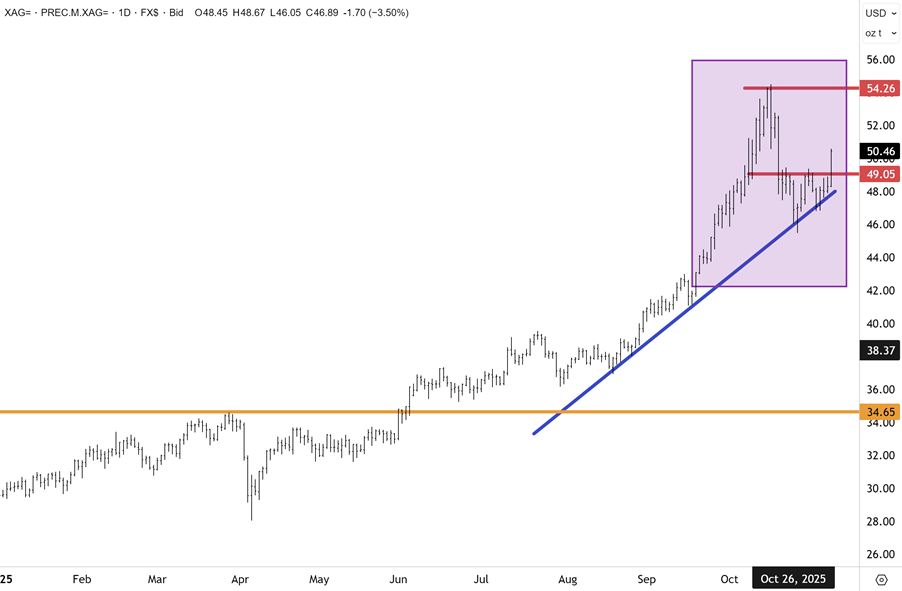
Silver has had a similar outcome to gold this week. Silver spot prices have surged through topside resistance at $49 to reach nearly $51 on Monday. The peak-to-trough selloff defined a 15% corrective selloff. But since mid-October, silver has put in a series of higher reaction lows, which points to upward momentum now resuming. The silver miners, which all corrected sharply in line with spot prices, are also confirming the move.
Yesterday, I listened to an interview on Bloomberg with Mark Mobius (89), who was a pioneer of emerging markets fund management over many decades. He is another wise old sage who has seen it all over a fifty-year career in financial markets. The legendary fund manager and founder of Mobius Capital Partners said he foresaw a big correction coming for top names in the AI space as valuations soar. “A correction could tank the top AI stocks by as much as 40%. When I look at a correction, I look at 30%, down 30%, 40%. That will happen, but it will be short-lived.”
Mr Mobius believes in the long-term uptrend for AI and the impact on the global economy, which I do as well. However, timing a correction might be difficult near term, especially given the Fed is likely to soon lean into a more dovish stance. However, one day he will be right, but for now, earnings momentum is strong, and investors will not want to get in the way of a Fed that is easing.
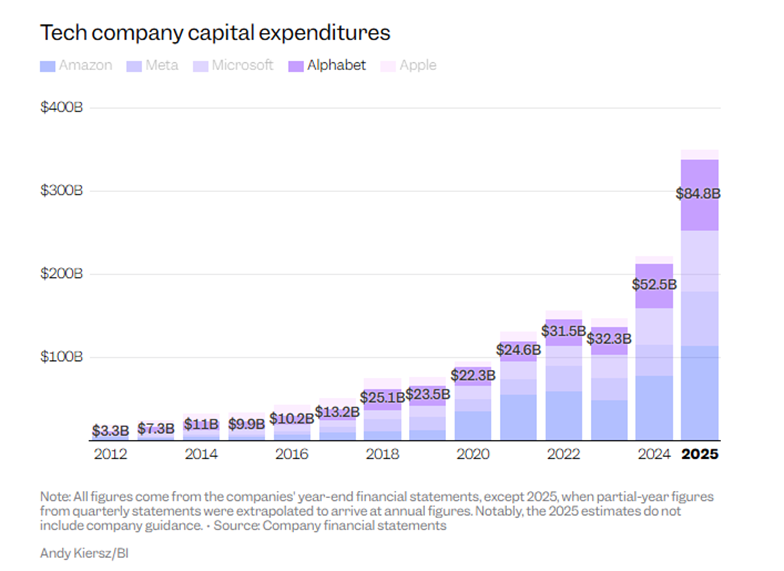
Mr Mobius mentioned that he was mainly concerned about high valuations and heavy spending in the AI space. “AI investment at some firms is probably excessive. We’ve got to be prepared for a pullback. And you buy the dip. I’d love to see a pullback of 30%, 40%. I would be in there with both arms and legs. We’d be buying a lot.”
In the meantime, there’s one area of the market Mobius thinks could be a promising buy for investors: emerging market stocks. Like us, Mr Mobius is bullish on China and sees opportunity there with valuations skewing much less expensive. He noted that “emerging markets have outperformed the US market so far this year and that the iShares MSCI Emerging Markets ETF is up 29.7% year-to-date, outpacing the S&P 500’s 13.8% gain. The index is largely up due to strength in Chinese and Indian stocks. China’s economy is “moving up” the technology ladder, and India is also developing in the computer hardware space — two things that could help fuel a rotation back to EM assets”.
I have made this point on many occasions, and China could further surprise next year in terms of closing the technology gap with the US. This is not fully reflected in valuations for leading Chinese technology bellwethers. Mr Mobius also pointed to tailwinds like the Fed cutting rates, “which lowers the value of the US dollar relative to other currencies and can give foreign firms more buying power. These two powerhouses will really make emerging markets look very good. Of course, that will swash over into other emerging markets.” I am going to discuss the US dollar in greater detail later this week.
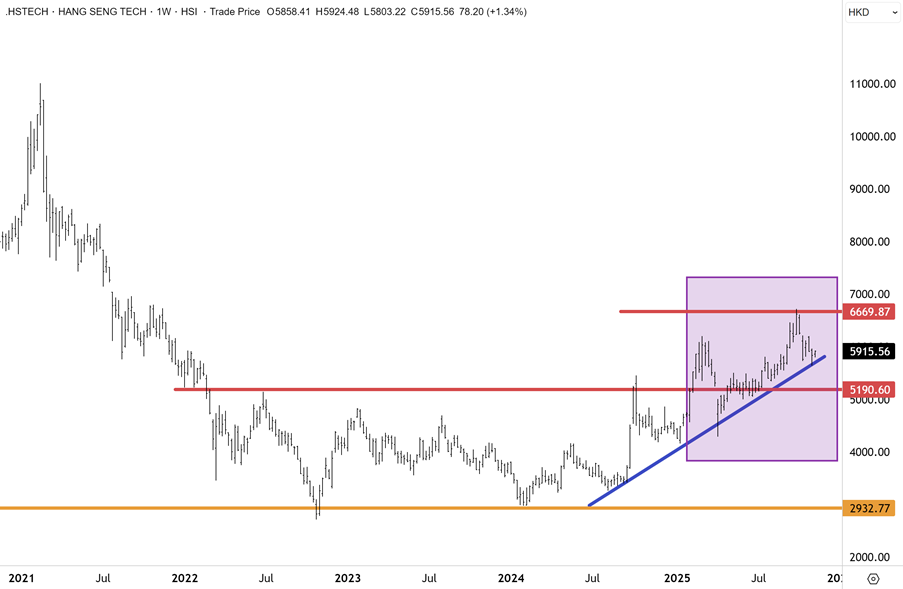
The Hang Seng Tech index has corrected close to 13% peak to trough since early October, but support is now being found at the uptrend in place since the July lows in 2024. I am anticipating an upward dynamic soon, and for upward momentum to carry the Hang Seng Tech index back towards the three-year highs above 6,700 in the coming months. Similar to the US reporting season, major Chinese technology companies, which the HS index comprises, have all reported solid earnings growth, but valuations remain at a significant discount.
Finally, RBA Deputy Governor Andrew Hauser’s speech garnered some market attention yesterday. Mr Hauser said that the central bank is wrestling with an economy that doesn’t seem to have much slack without risking an inflationary outcome. Those comments lifted the Aussie dollar by dampening further rate cut hopes.
He said, “The bigger picture challenge for the economy over the medium term, if we are to return to the sort of growth rates we have been used to, is how to create more supply capacity.” Maybe it was the recent Melbourne Cup, but he seemed to lean in on some racehorse metaphors, continuing by saying, “If we fail to do so, we may find ourselves boxed in on the rail. If we succeed, we could be off to the races.”
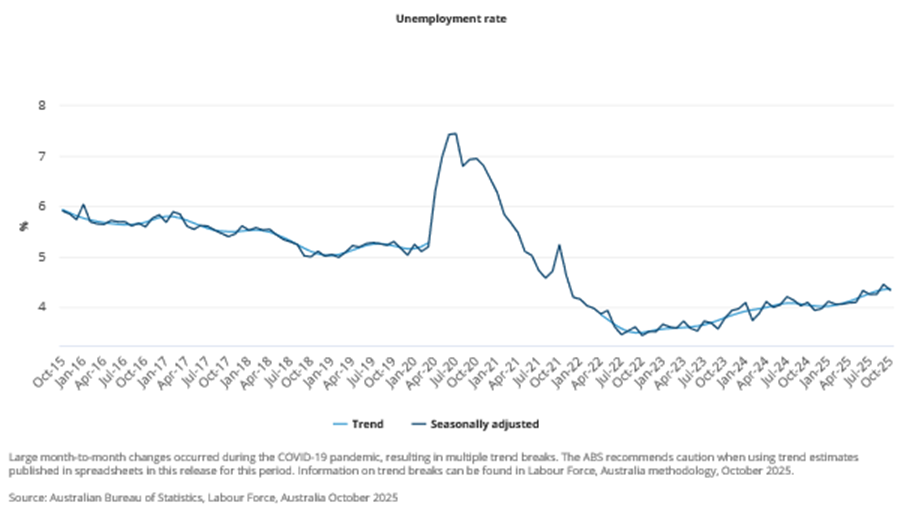
The comments followed the RBA’s decision on November 4th to hold the cash rate at 3.6% after three cuts this year. Policy makers are constrained by underlying inflation quickening to 3% last quarter, and unemployment edging up to 4.5% in September. I am more concerned about the unemployment rate, which is higher than in the US. Any further deterioration of the UE rate towards 5% will mount significant pressure on the RBA and put them in a dilemma.
While the current combination of inflation and UE has the RBA neutral for now, even as the Federal Reserve delivered a second straight cut last month. Mr Hauser said the backdrop reflects the demand surge of 2021–22, a deliberately cautious tightening path compared with peers, and sluggish supply growth. He is, however, likely being too conservative.
Traders and economists took the message as signalling no further cuts. Goldman Sachs called it another turn away from dovishness and expects the RBA to stay on hold at 3.6%, while UBS also sees 3.6% as terminal and judged the tone hawkish. Mr Hauser sketched three paths. More easing if slack reappears; little scope to stoke demand without reigniting prices, or supply expands and growth lifts. He called parts of the inflation spike temporary and said stagflation isn’t the central case. Let’s hope the RBA moves quickly if the unemployment rate and labour market continue to roll over.
Defying gravity
Volatility has made a return on Wall Street during November following a big rally and little in the way of a correction during prior months, which seasonally are the weakest time for the stock market. Despite the swings, once markets have more clarity on the state of the economy as the fog lifts, I believe upside momentum will return and global equities will have a strong finish into year-end. However, valuations in the US are expensive, with the SPX priced on a forward PE of more than 23X, with Mag 7 accounting for over 35% of the index. The relative outperformance of international benchmarks this year versus the US is likely also to continue.
Morgan Stanley’s CIO Mike Wilson highlighted this week that while the “earnings season has led to high performance and earnings estimate dispersion under the surface, we continue to see incrementally positive developments at the index level… the median stock is seeing its best earnings per share growth in 4 years, and the S&P 500 revenue beat rate is running at two times the historical average – clear signs that the earnings recovery is accelerating and that pricing power is firming, in our view.” Despite near-term uncertainty around the path of rate cuts and the state of the US economy, third third-quarter earnings season has confirmed the robust state of the corporate sector. This points to the rally continuing in December and possibly new record highs for the US benchmarks.
Mr Wilson made one observation and noted that there are “clearer signs of seasonal weakness in earnings revisions breadth being over, and the next leg higher in this critical guidance gauge is underway. Specifically, this measure troughed at 6% on October 21st and is now at 11%. At the industry level, this recent rate of change improvement is being led by Software, Transports, Energy, Autos and Healthcare…despite this improvement in earnings revisions, the market traded heavy last week on the back of two risks, in particular.” I agree, and the setup favours a strong finish into year-end and a good start for 2026.
He also made an interesting observation about Canada which is interesting. Canada’s “unemployment rate has gone up much more than it has in the US, but in a break from history, their equity market has gone up as the unemployment rate has risen. Why? For one, their central bank has cut the policy rate by almost 300bps since last June.”
MS noted that “in addition, the weakness in the jobs market has been moderately paced as an acute shock tied to a non-linear rise in the unemployment rate has been avoided (as it has in the US). Interestingly, the Canadian job market weakness appears to now be stabilising following this policy response, as our economists point out. There are, of course, differences in economic and equity composition between the two countries, but this could be an instructive parallel to some degree to the extent one believes softness in alternative jobs data portends moderate weakness in “official” US jobs data.”
There is no question that the pace of hiring in the US has slowed down markedly this year, and we might even see a sharp jump in unemployment when official statistics and data soon resume. However, this will prompt the Fed into action soon and if not in December, then aggressively next year. As we have seen in Canada, the central bank has cut rates by 300bps, which has helped the key benchmark, the S&P/TSX Composite, defy gravity and surge in recent weeks to new record highs. The UK has a similar setup where the FTSE has also made new record highs despite a sluggish economy. The US is set to follow a similar path soon, in my view.

And with US rates headed lower, I still see the dollar falling sharply next year and resuming a downward trend. This outcome will maintain a “risk-on bid” in asset markets, and likely also another upward leg for international equities and notably emerging markets, where we are advocating overweight positioning in China/Hong Kong and Japan.
In Australia, the October employment report bucked the global trend and delivered a double blow to rate cut expectations. While the strength in the job market is always welcome, the RBA is likely now to defer another cut until February next year. However, key data around the economy has been volatile and patchy.
The economy added 42,200 jobs against forecasts of 20,000, with full-time employment surging by 55,300 positions. More striking was the unemployment rate’s decline to 4.3% from 4.5%, undershooting the 4.4% consensus. The participation rate held steady at 67% while “underemployment” improved to 5.7%. Overall, this painted a picture of much more sustained labour market tightness than expected.
The unemployment rate surprised on the downside
Money markets responded swiftly, with swaps showing the probability of another rate cut by May 2026 at just 25%, down from about 70% before the data dropped. This might be overdone.
Policy-sensitive 3-year government bond yields jumped alongside the stronger Aussie dollar. I note the AFR reported that ANZ is sticking with one more rate cut from the RBA this cycle, “likely in February.” On the other hand, NAB’s chief economist Sally Auld no longer expects any more cuts over the bank’s forecast horizon.
Carpe Diem
Sign up to receive full reports for
the best stocks in 2025!
Where to Invest in 2025?
The market is full of opportunities—but which stocks will deliver real wealth-building potential?
At Fat Prophets, our expert analysts uncover the best Australian and global stocks to help you stay ahead of the curve. Whether you’re looking for growth, income, or diversification, our carefully curated portfolio gives you access to high-conviction stock recommendations backed by deep research and proven insights.
Subscribe now to get full reports of these stocks and get ready for the next big opportunities!
Over 25,000 customers worldwide

Need a try? You’re first-time customer?
Enjoy our Welcome Gift with $500 OFF your Membership
Use code: FPWELCOME
FAQ’s
How much does a Membership cost?
We have a number of Membership options for the DIY investor. Our research services cover individual stock opportunities in Australia, as well as the UK, global markets, and a sector-specific report focussing on the mining space. Annual Membership prices start at $1395.
Do you offer execution services?
No we do not, and our research is independent in the sense that we are not conflicted by operating broking services alongside them. We also do not offer ‘sponsored research’ and are not financially incentivised by any of the companies that we recommend to Members.
Can I access any special offers?
Our introductory joining offers relate only to new Members. We do however offer ‘early bird’ discounts to existing Members who renew in advance of their Membership expiring.
Can I get tailored financial advice?
Our research products are ‘general advice’ in nature only, however we do categorise all our recommendations by the level of risk appetite which we believe is involved. Members looking for more direct advice can also make an inquiry to our wealth management team which offers a separately managed accounts service.
Do you offer a Money-Back guarantee?
Yes we do. Fat Prophets offers a 100% money back guarantee on annual subscriptions within 30 days of taking out a Membership.
